The cost of an AI agent is decided by eight things: how much it decides for itself, how many systems it connects to, the state of your data, the languages and channels it works in, what a mistake costs, how much volume it handles, where it has to run, and who looks after it after launch. Settle those before you ask for a quote, and split every quote into build, run and upkeep.
"How much does an AI agent cost?" is the first question most buyers ask, and the one a careful builder cannot answer in the first meeting. Two agents that sound the same in a sentence can differ several times over in effort, depending on details that only come out when you look at the process.
So this guide has no price list. It gives you the eight things that decide the cost, so you can work out which end of the range you are at, cut the scope where it is cheap to cut, and compare quotes on the same footing.
Why there is no single price
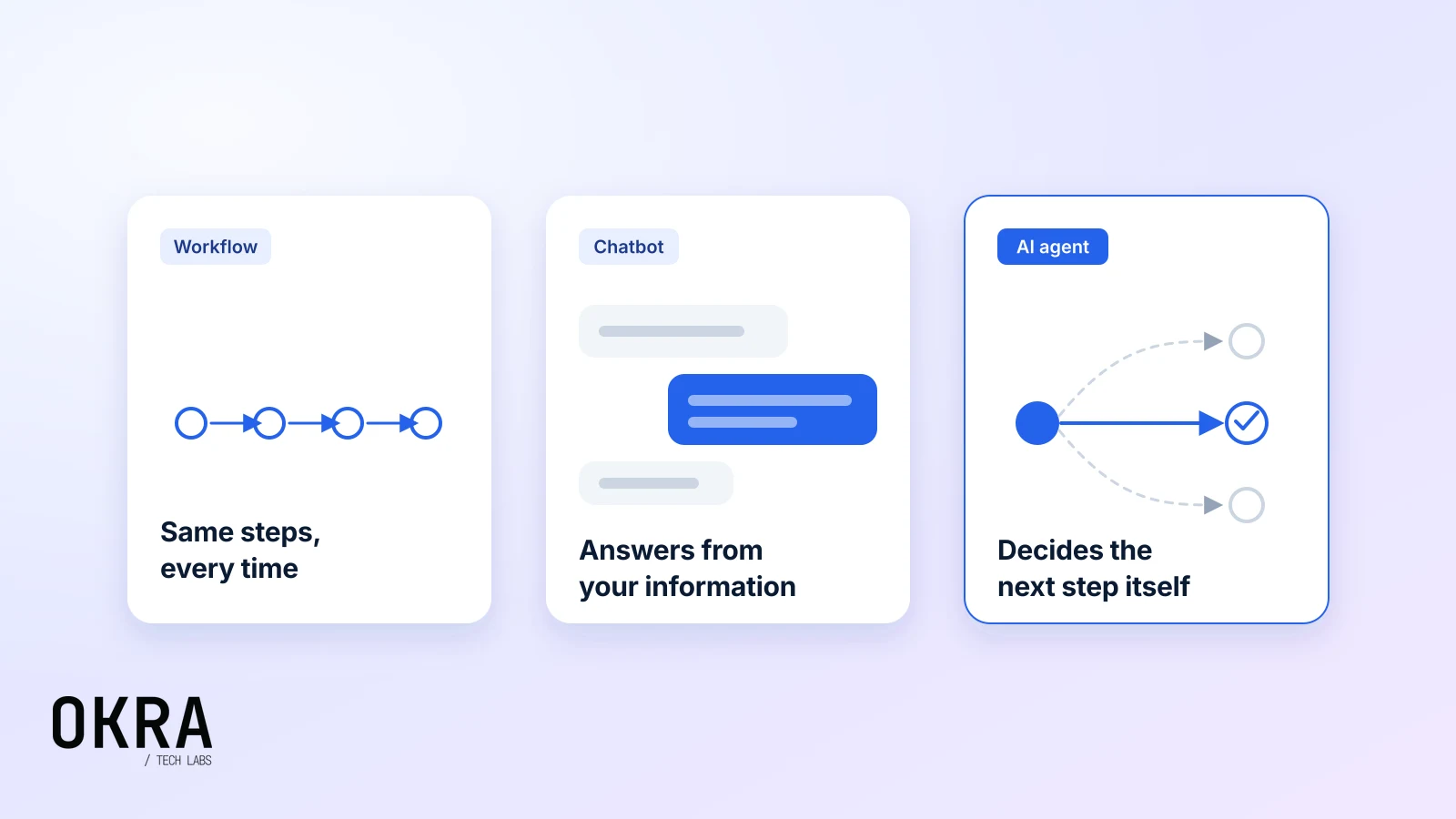
An AI agent is not one product. Anthropic's guide to building effective agents separates workflows, where the steps are written in code in advance, from agents, where the model chooses its own steps and tools. It says plainly that agentic systems often trade speed and cost for better results, and advises finding the simplest solution that works, which sometimes means not building an agent at all.
Cost is also where many projects end. Gartner predicted in June 2025 that over 40% of agentic AI projects will be cancelled by the end of 2027, and named rising costs among the reasons, next to unclear business value and weak risk controls. A budget built on a round number, without the details below, is how a project joins that group.
The eight things that decide the cost
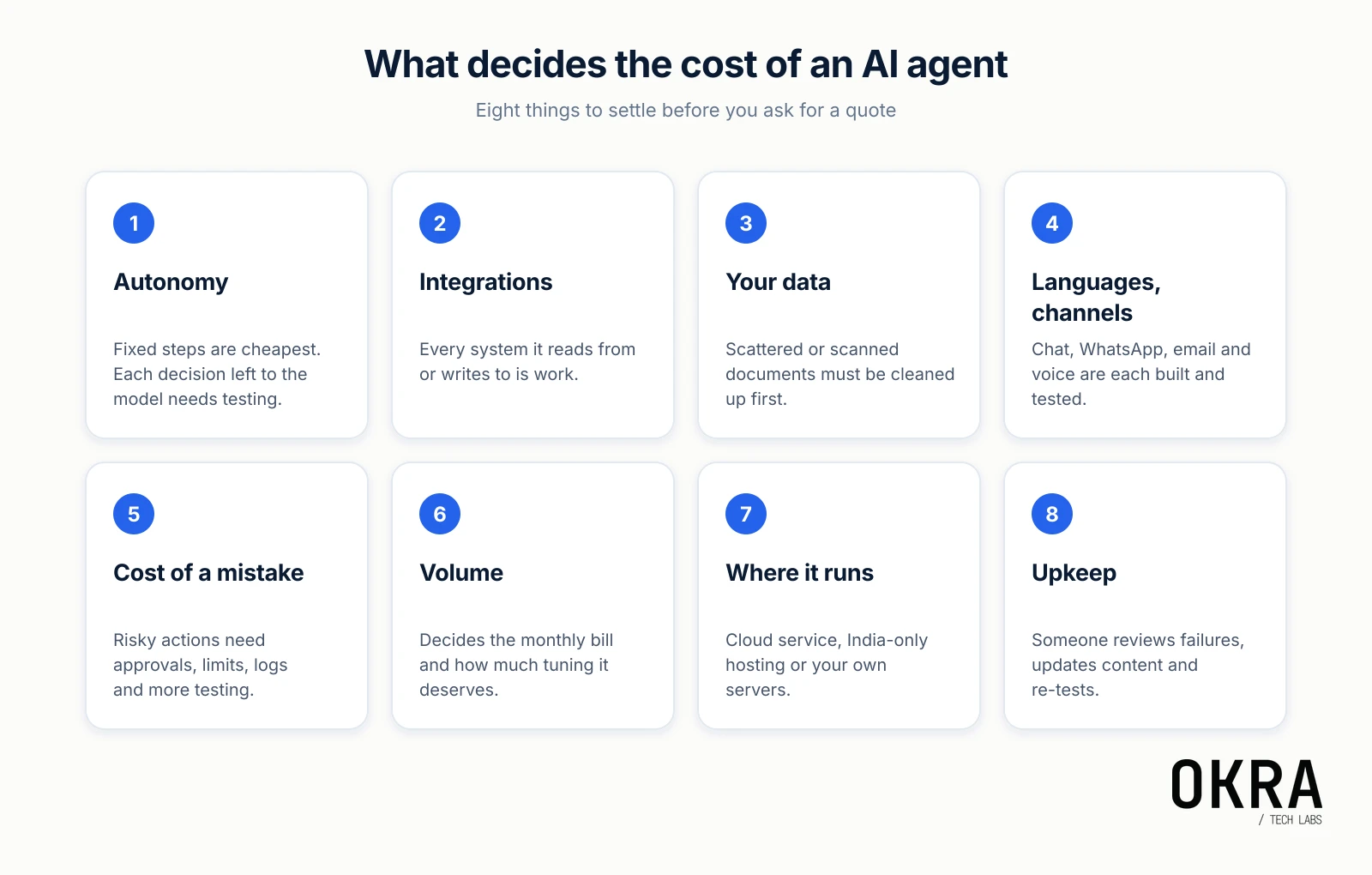
1. How much the agent decides for itself
A system that follows fixed steps is the cheapest to build and test. Each decision you hand to the model adds paths that have to be tested. If you are unsure which one you need, our guide to agents, chatbots and workflow automation covers the choice.
2. How many systems it connects to
Every connection is work: the CRM, the ERP, WhatsApp, the payment gateway, a spreadsheet someone updates by hand. Systems with a clean, documented interface are quick. Old software with no interface is slow. Anthropic's guide says to put as much care into the tools an agent uses as into the prompt, and that its own team spent more time on tools than on the prompt for one coding agent.
3. The state of your data
An agent answers from what you give it. If price lists, policies and product details live in scanned files, old emails and three versions of the same sheet, someone has to clean them up first. This is often the largest hidden item in a build.
4. Languages and channels
Text chat in English is the simplest case. Each added channel (WhatsApp, email, phone calls) and each added language has to be built and tested on its own. Voice adds telephony and speech on top. If your customers speak Indian regional languages, plan for native speakers to review the output.
5. What a mistake costs
An agent that drafts a reply for a person to approve needs light guardrails. An agent that issues refunds or changes bookings needs approval steps, limits, logs and far more testing. Anthropic's guide notes that autonomy brings higher cost and the risk of errors that build on each other, and recommends heavy testing in a safe environment, checkpoints for human review and a cap on the number of steps.
6. Volume
Volume decides the running bill, and whether it is worth engineering that bill down. A handful of tasks a day can run on the most capable model without much thought. Thousands a day need care over which model handles which step.
7. Where it has to run
Using a model through a provider's cloud service is the cheapest way to start. If your sector's rules or your customers require data to stay in India, or on your own servers, hosting and operations become part of the cost. Our post on the DPDP Rules and AI systems explains what the law asks for.
8. Who looks after it after launch
Models change, your prices and policies change, and customers find new ways to ask things. Someone has to review failures, update the content and re-test. Leaving this out of the budget is one of the reasons pilots never reach production.
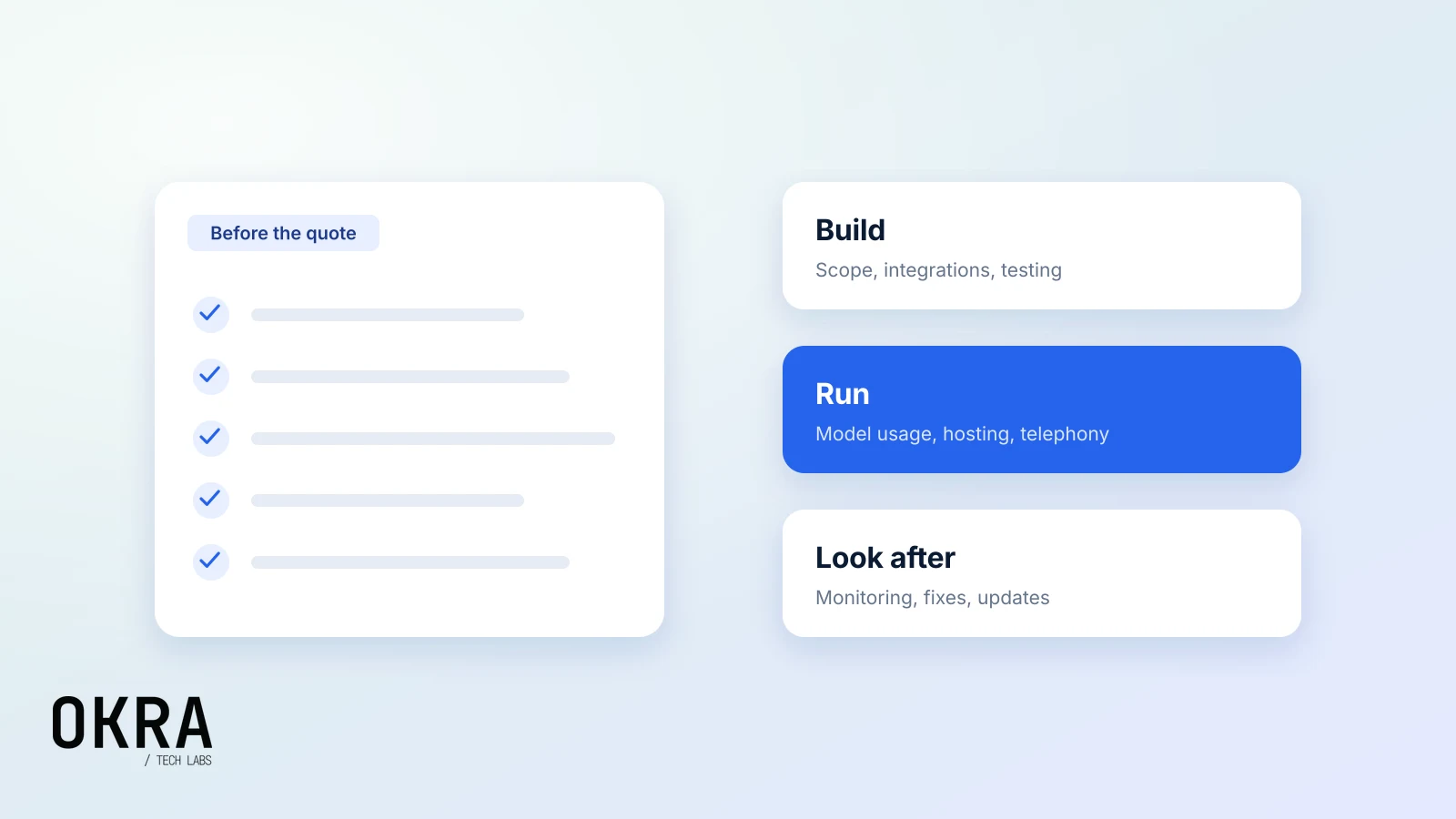
Build, run and upkeep are three different bills
Ask for every quote in three parts.
- Build: scoping, integrations, data clean-up, testing and launch. Paid once.
- Run: model usage, hosting, and messaging or telephony charges. Paid every month and tied to volume.
- Upkeep: monitoring, fixes, content updates and re-testing when a model changes.
The run bill is the one buyers underestimate. Model providers charge by the amount of text a model reads and writes. On Anthropic's price list, for example, text the model writes costs five times as much as text it reads on the current main models, and the model tiers differ widely in price. An agent that takes ten steps to finish a task reads its instructions and history again at each step, so usage climbs with autonomy.
The same page shows how that bill can be engineered down: a 50% discount for work that can wait and be processed in batches, and cached instructions that are re-read at a small fraction of the normal input price. Ask your builder which of these they plan to use.
How to bring the cost down before you ask for a quote
- Pick one process, not a department. A narrow first version is cheaper, and it teaches you what the second one needs.
- Cut integrations. Does version one need to write to the ERP, or can it send a summary to a person who does?
- Clean the source documents. One current price list and one policy document save days of work.
- Keep a person on risky actions. Approval steps cost less than the testing needed to remove them.
- Agree the success measure first. A goal with a number stops the scope from drifting.
Six questions to put to any builder
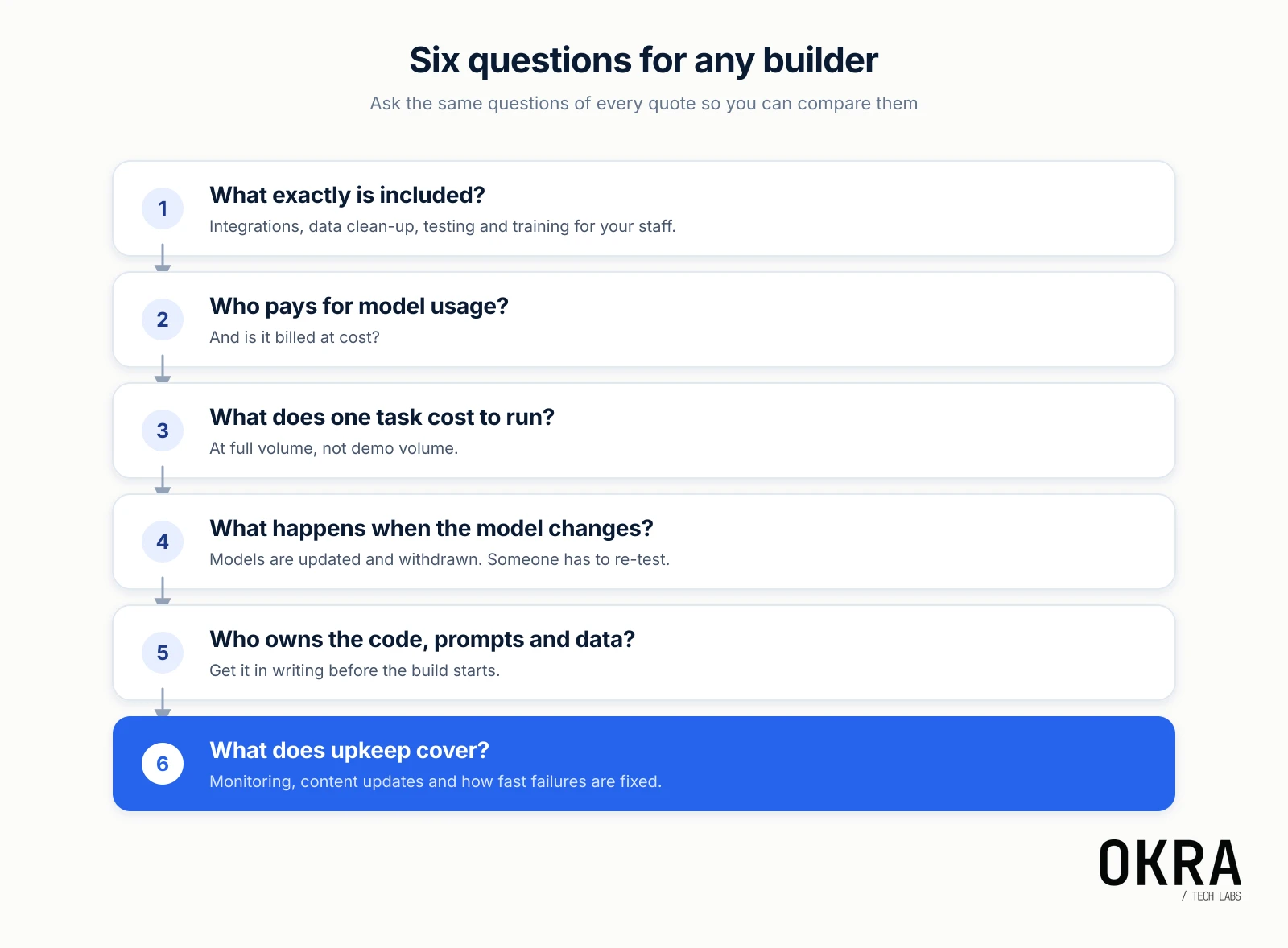
- What exactly is included? Integrations, data clean-up, testing and training for your staff.
- Who pays for model usage, and is it billed at cost?
- What does one task cost to run at full volume, not demo volume?
- What happens when the model is updated or withdrawn?
- Who owns the code, the prompts and the data?
- What does upkeep cover, and how fast are failures fixed?
A builder who can answer all six has thought about your running costs, not only the build. One who offers a price before asking about your process has not.
Questions people ask
How much does it cost to build an AI agent in India?
There is no honest single figure. The cost depends on how much the agent decides for itself, how many systems it connects to, the state of your data, the languages and channels, the cost of a mistake, the volume, where it must run and who maintains it. A quote given before those are known is a guess.
What is the biggest running cost of an AI agent?
For most agents it is model usage, which is billed by the amount of text read and written, plus hosting and any messaging or telephony charges. Usage grows with every step the agent takes, so an agent that makes many tool calls per task costs more to run than a fixed workflow.
Is a workflow cheaper than an AI agent?
Usually, yes. A workflow follows steps written in advance, so it needs less testing and uses fewer model calls. An agent chooses its own steps, which costs more to test and run. Use an agent only where the steps cannot be known in advance.
How can I reduce the cost of an AI agent project?
Start with one process, cut the number of systems it must connect to, clean up the documents it will rely on, use a smaller model for simple steps, and agree a measurable goal before the build starts so the scope does not drift.