Use workflow automation when the steps are known and fixed, a chatbot when people need answers from your information, and an AI agent only when the system must decide its own next step across tools. Most businesses need the first two before they need the third.
Almost every AI product launched this year calls itself an agent. Some are. Many are a chatbot with a new label, and some are a workflow that would run just as well without a language model at all.
That matters because the three cost different amounts to build, fail in different ways, and suit different problems. Pick the wrong one and you either pay for complexity you never use, or you get a system that cannot do the job.
This guide explains the difference in plain terms and gives you a test you can run on your own use case.
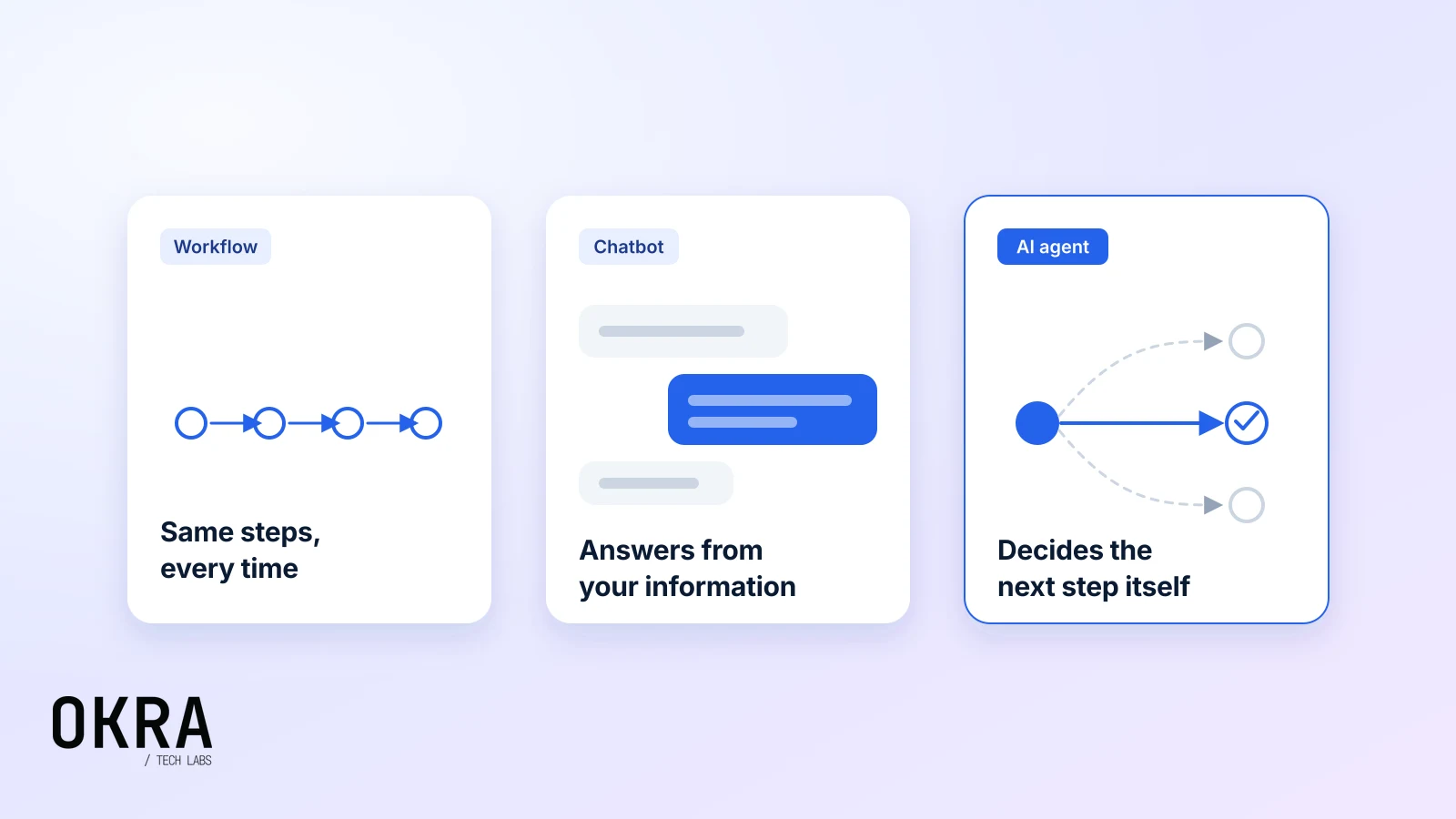
The short version
| Workflow automation | Chatbot | AI agent | |
|---|---|---|---|
| What it does | Runs fixed steps in a set order | Answers questions in a conversation | Decides its next step and acts in other systems |
| Who decides the steps | You, in advance | Mostly you; the bot picks an answer | The system, while it runs |
| Good for | Invoices, lead routing, reports, reminders | FAQs, order status, policy questions | Multi-step tasks where each case is different |
| Main risk | Breaks when an input looks unusual | Confident wrong answers | Wrong actions, cost and hard-to-trace failures |
| Testing effort | Low | Medium | High |
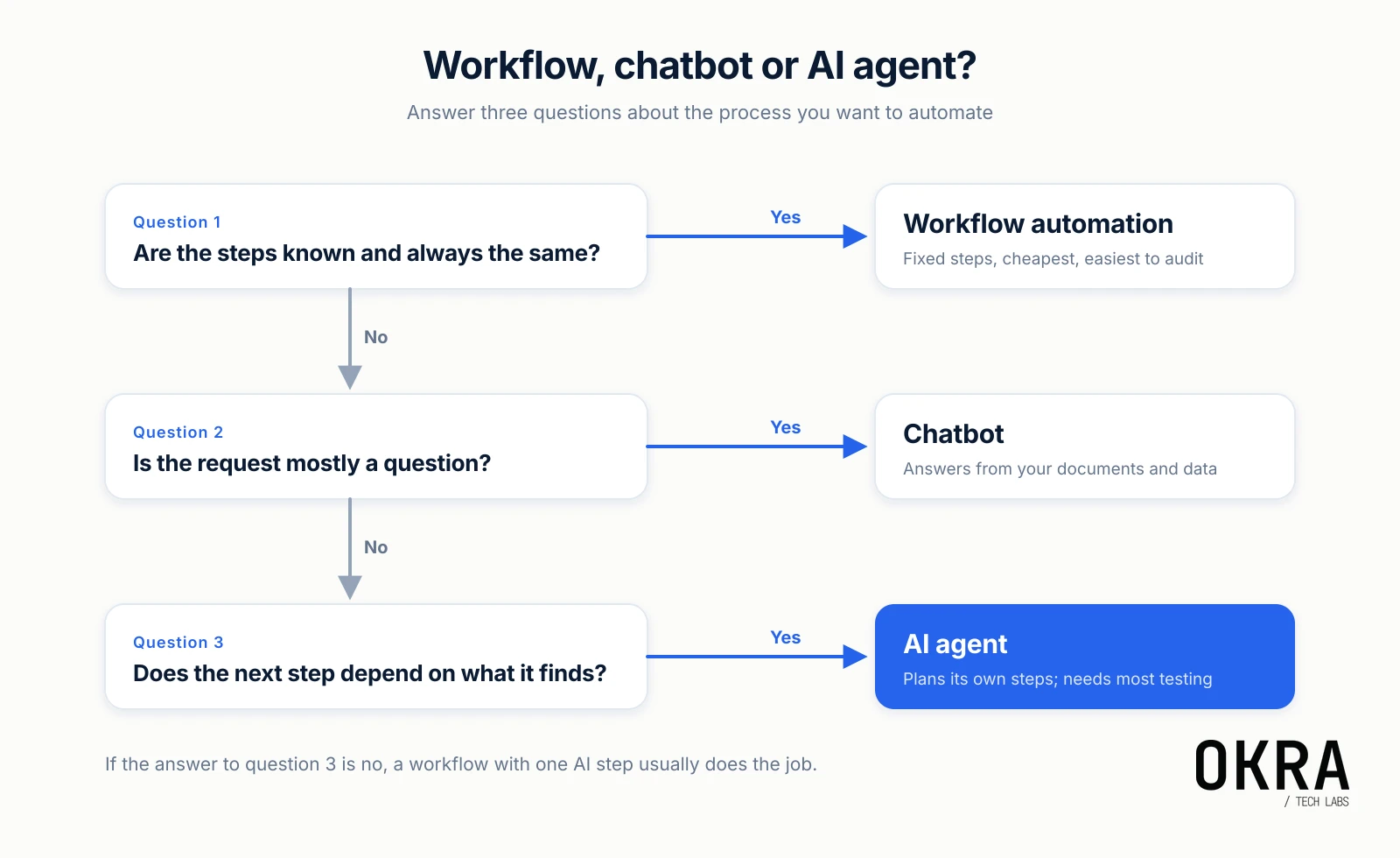
Workflow automation: when you already know the steps
A workflow is a recipe. When a new lead arrives, add it to the CRM, send a WhatsApp message, notify the sales manager and book a follow-up task. The steps never change; only the data does.
Modern workflows often use AI inside a single step. A model might read a scanned invoice, pull out the amount and the supplier name, and hand them to the next step. That is still a workflow, because the order of steps is written down in advance.
Anthropic's engineering team draws the same line: in their guide to building effective agents, workflows are systems where the model and tools run through predefined code paths, while agents direct their own process and tool use.
Choose workflow automation when:
- you can draw the process on a whiteboard, and it looks the same every time
- a mistake in one step should stop the process rather than improvise
- you care most about predictable cost and easy auditing
Chatbots: when people need answers from your information
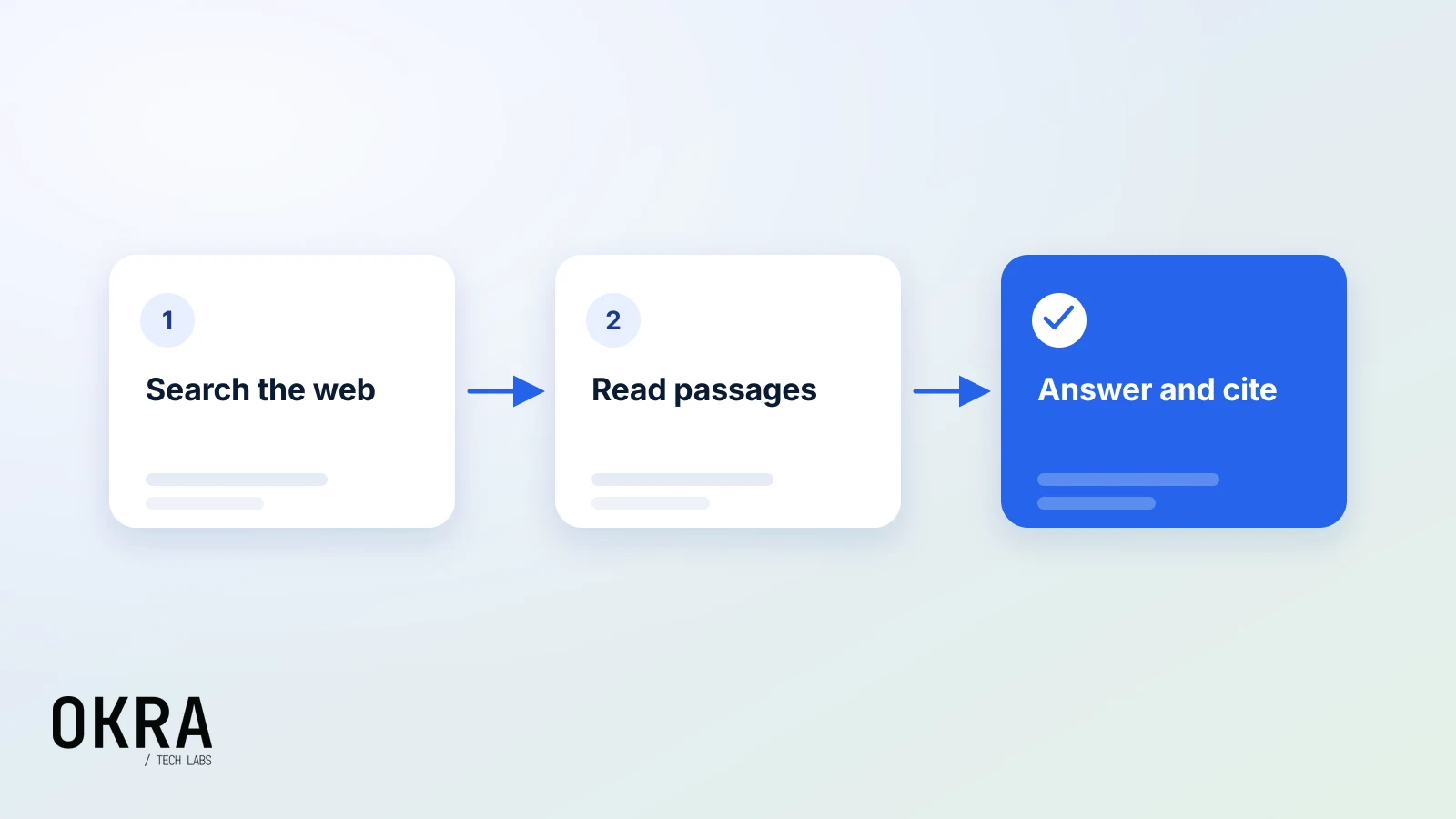
A chatbot holds a conversation. A good one answers from your own material: product sheets, policies, price lists, past tickets. This is usually done by retrieving the right passages and letting the model write the answer from them.
A chatbot is the right tool when the job is mostly telling people things. What are your clinic timings? Is this flat RERA registered? Where is my order? It may look up one record, but it does not run a sequence of actions on its own.
The main risk is a confident wrong answer. You manage that with a tight source of truth, answers that cite where they came from, and a clear handover to a person when the bot is unsure.
Choose a chatbot when:
- most requests are questions, not tasks
- the answers live in documents or a database you control
- a person can take over the conversations the bot cannot finish
AI agents: when the system has to decide what to do next
An agent is given a goal and a set of tools, and works out the steps itself. Reschedule this patient's appointment, find a slot that suits them, move the doctor's calendar, and send a confirmation in the patient's language. Each case is different, so no fixed recipe covers it.
That flexibility is the point, and also the cost. Agents make more model calls per task, take longer, and can take a wrong action rather than give a wrong answer. Anthropic's guide makes the same trade explicit: agentic systems spend more time and money to perform better, so start with the simplest thing that works and add autonomy only when it is needed.
Analysts are seeing the result of skipping that advice. In June 2025, Gartner predicted that over 40% of agentic AI projects will be cancelled by the end of 2027 because of rising costs, unclear business value or weak risk controls. The same release warned about "agent washing", where existing chatbots and automation tools are rebranded as agents without real agentic capability.
Choose an agent when:
- the task needs several steps across different systems
- the right next step depends on what the previous step found
- the value of each completed task is high enough to justify the extra cost and testing
A five-question test for your use case
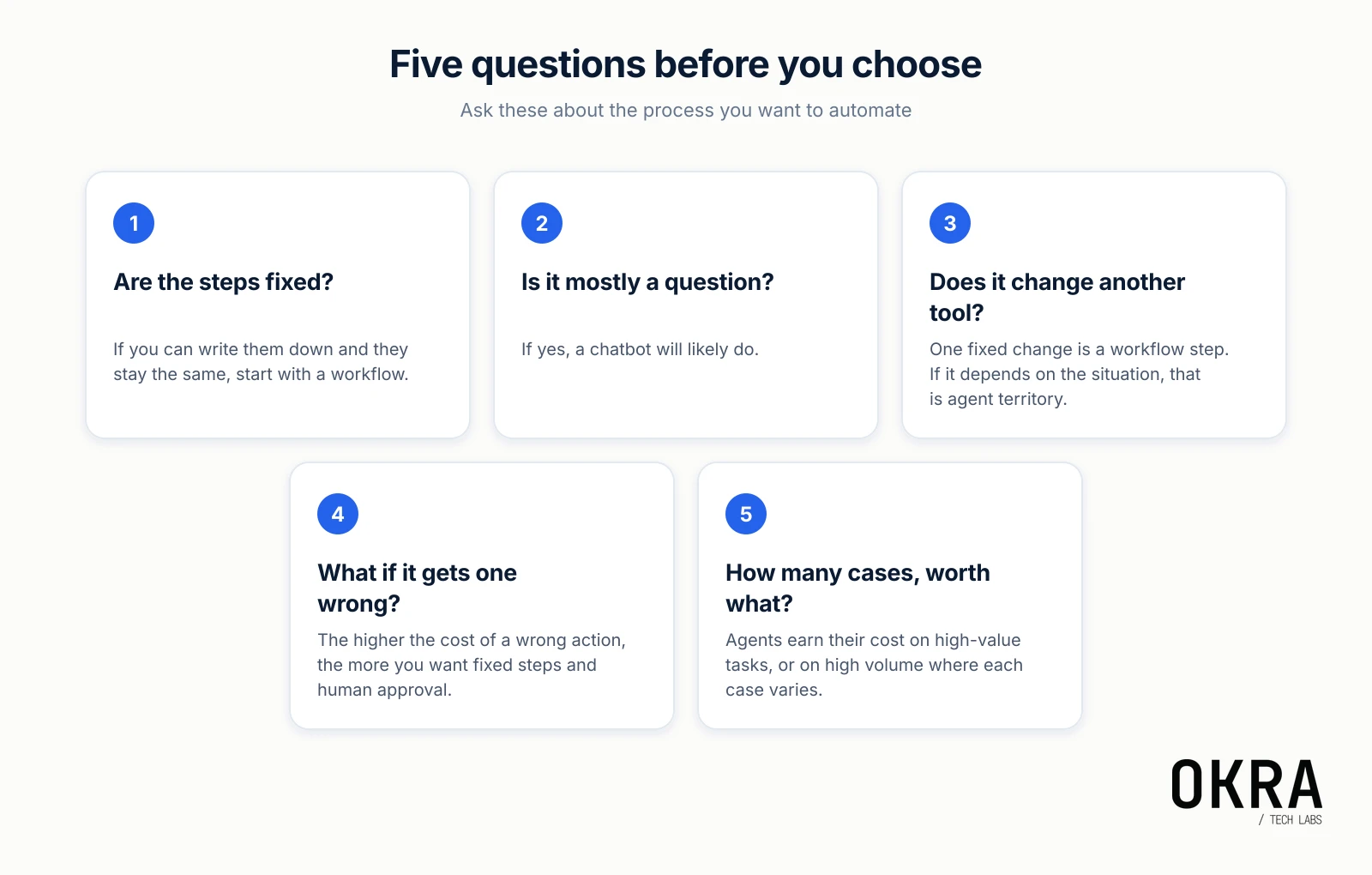
Answer these about the process you want to automate:
- Can you write the steps down, and do they stay the same? If yes, start with a workflow.
- Is the request mostly a question? If yes, a chatbot will likely do.
- Does the system need to change something in another tool (a booking, a CRM record, a payment link)? If it is one fixed change, a workflow step handles it. If it depends on the situation, you are moving into agent territory.
- What happens if it gets one case wrong? The higher the cost of a wrong action, the more you want fixed steps and human approval.
- How many cases a day, and what is each one worth? Agents earn their cost on high-value tasks or high volume where each case varies.
An example
Take a real estate developer's enquiry line (an example, not a client).
- Sending every new portal lead a WhatsApp brochure within a minute is a workflow.
- Answering "what is the carpet area of the 3 BHK?" or "is there a clubhouse?" is a chatbot.
- Calling the lead, understanding that they want a site visit on Saturday but only after 4 pm, checking the sales team's calendar, booking a slot and messaging the right salesperson is an agent, because every call goes differently.
Most developers need all three, in that order. Building the agent first, before the simple workflow exists, is how projects end up expensive and fragile.
How we approach it
When a business comes to us, we map the process first and mark which steps are fixed, which are questions and which need judgement. We build the fixed parts as plain workflows, put a chatbot or voice agent where people ask questions, and reserve agent behaviour for the steps that really need it. Every agent action that touches money or a customer record gets a log and, where it matters, a human approval step.
That keeps the system cheaper to run, easier to test, and much easier to explain to the people who depend on it.
Questions people ask
What is the difference between an AI agent and a chatbot?
A chatbot answers questions in a conversation, usually from a fixed set of information. An AI agent decides what to do next and takes actions in other systems, such as checking a booking, updating a CRM record or sending a follow-up, without a person choosing each step.
Is workflow automation the same as an AI agent?
No. Workflow automation follows steps that are written down in advance. It can use AI inside a step, for example to read an invoice, but the order of steps is fixed. An agent chooses the order itself.
Which one is cheapest to run?
Usually workflow automation, then a chatbot, then an agent. Agents make more model calls per task and need more testing and monitoring, so they cost more to build and run.
Can one system combine all three?
Yes, and many good systems do. A common shape is a chatbot at the front, fixed workflows behind it for routine requests, and an agent only for the cases that genuinely need judgement.