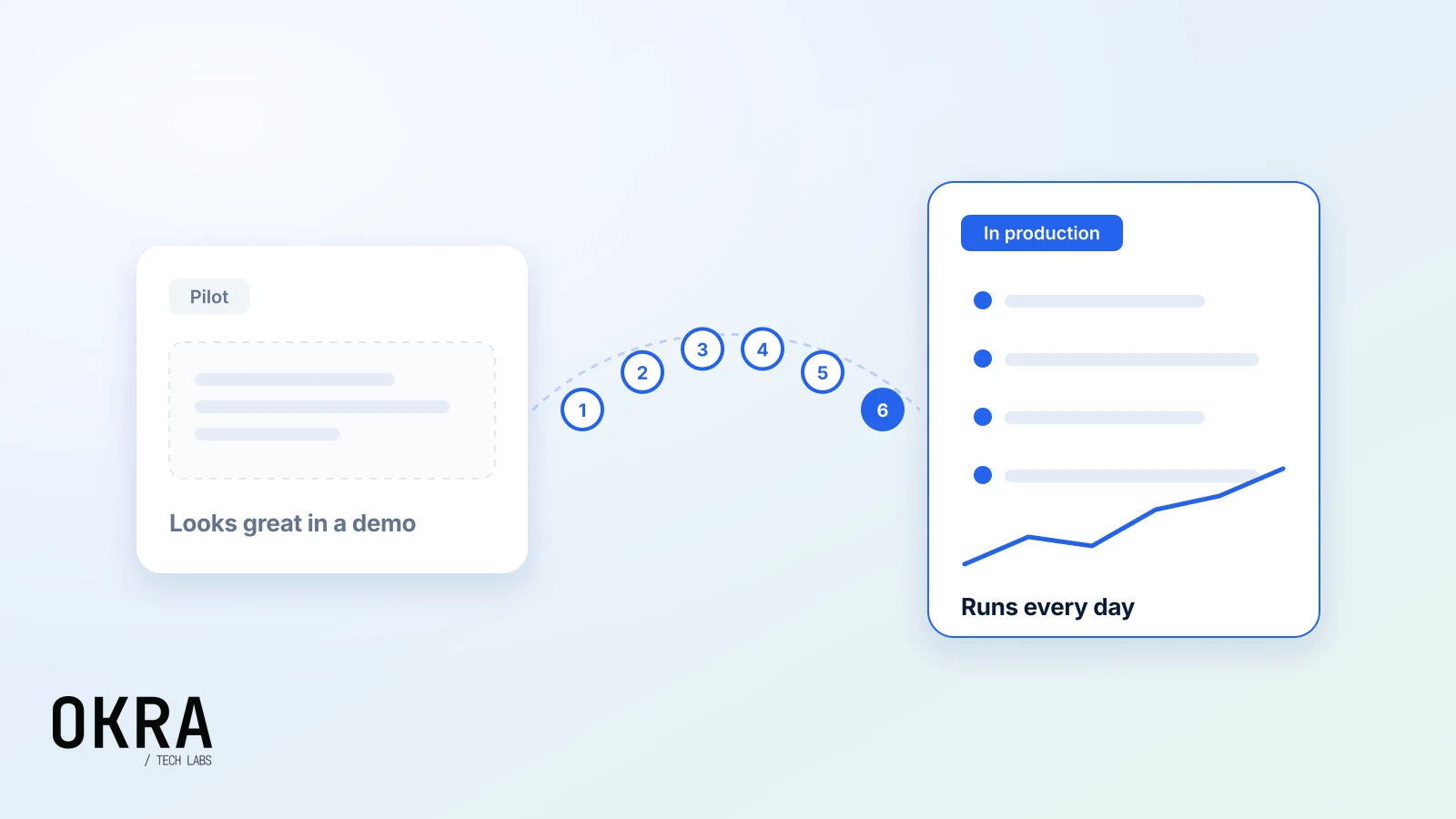
Pilots stall because they are built to impress in a demo, not to run inside a real workflow: no measurable goal, no plan for messy data, no owner, and costs nobody modelled. Start from one painful process, define success in numbers before building, test on real inputs, and plan the handover from day one.
Most companies that tried generative AI in the last two years have a demo they liked and a system nobody uses. The demo answered questions well in a meeting. Then it met real customers, real data and a real budget, and quietly stopped.
This is not a few unlucky projects. It is the normal outcome, and the reasons are well documented.
What the research says
Two widely cited studies point the same way.
MIT's NANDA initiative published The GenAI Divide: State of AI in Business 2025 in July 2025. As The Register reported, it found that only 5% of organisations had integrated AI tools into production at scale, despite US enterprises spending an estimated $35 to $40 billion on generative AI. The report's authors put this down to systems that do not retain context, adapt or learn over time, so they fail inside critical workflows.
Gartner's numbers are less dramatic but tell the same story. In July 2024 it predicted that at least 30% of generative AI projects would be abandoned after proof of concept by the end of 2025. Its later review found the real figure was at least 50%, citing poor data quality, inadequate risk controls, escalating costs and unclear business value.
The studies define failure differently, so do not read too much into the exact percentages. The pattern is what matters: most pilots are built in a way that cannot survive contact with daily operations.
The five reasons pilots stall
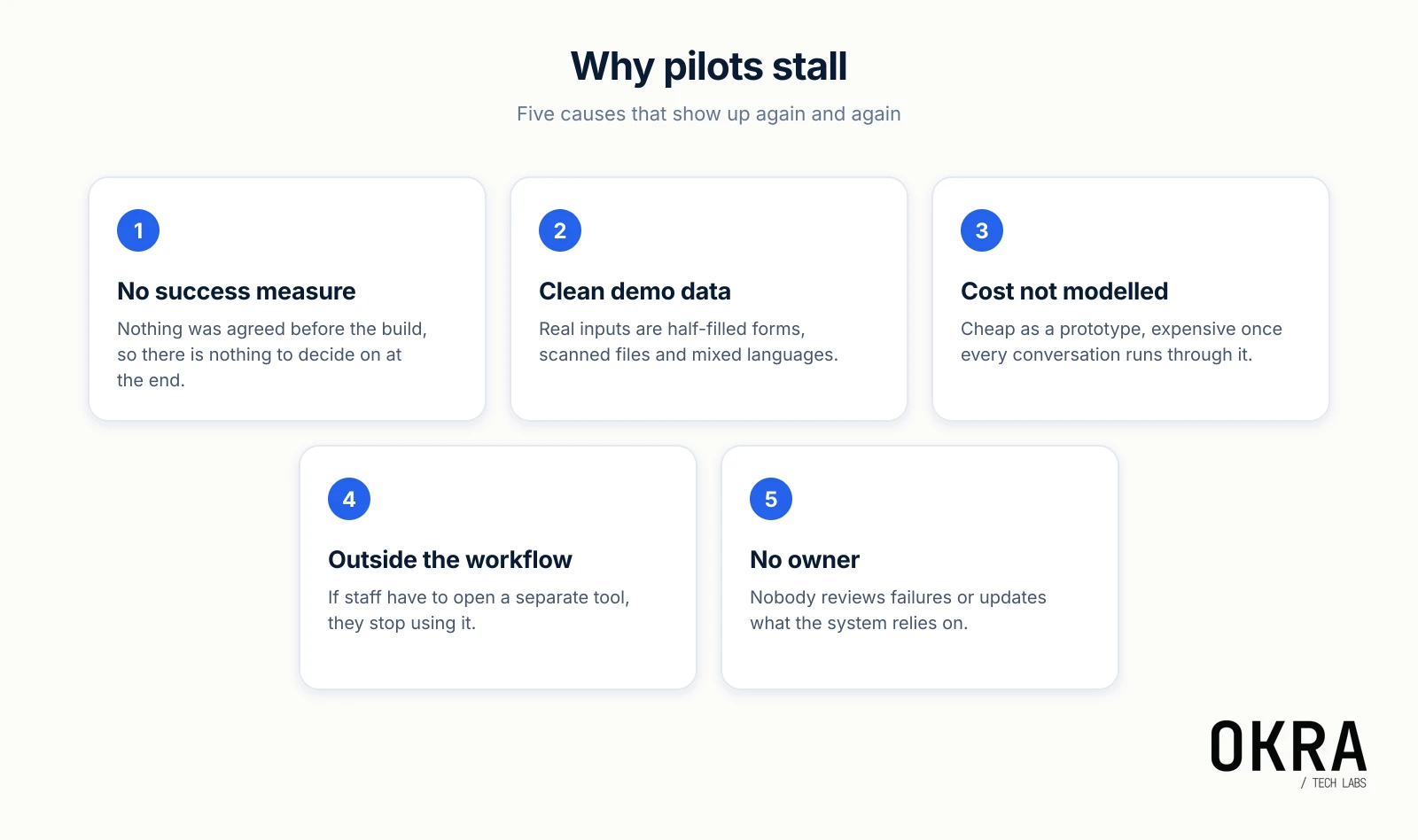
1. Nobody defined what success looks like. "Let's see what AI can do for support" is not a goal. Without a number agreed before the build (resolution rate, handling time, cost per enquiry), there is nothing to decide on at the end, and the project drifts until the budget is reallocated.
2. The demo used clean data; production does not. A pilot is usually tested on a tidy sample: well-written questions, complete records, one language. Real inputs are half-filled forms, spelling mistakes, scanned PDFs and customers switching between Hindi and English mid-sentence.
3. Costs were never modelled at scale. A prototype that costs little per day can become expensive when every customer conversation runs through it. Gartner calls out escalating total cost of ownership as a leading reason projects are cancelled after they look viable in testing.
4. It sits outside the real workflow. If staff have to open a separate tool, copy an answer and paste it into the CRM, they stop using it within weeks. MIT's report makes the same point about generic tools: they work for individuals but stall in enterprise use because they do not fit or learn the workflow.
5. No owner after the vendor leaves. Someone has to watch the system, review failures, update the knowledge it relies on and decide when to change it. If that person does not exist, the system decays.
The six steps we use to get to production
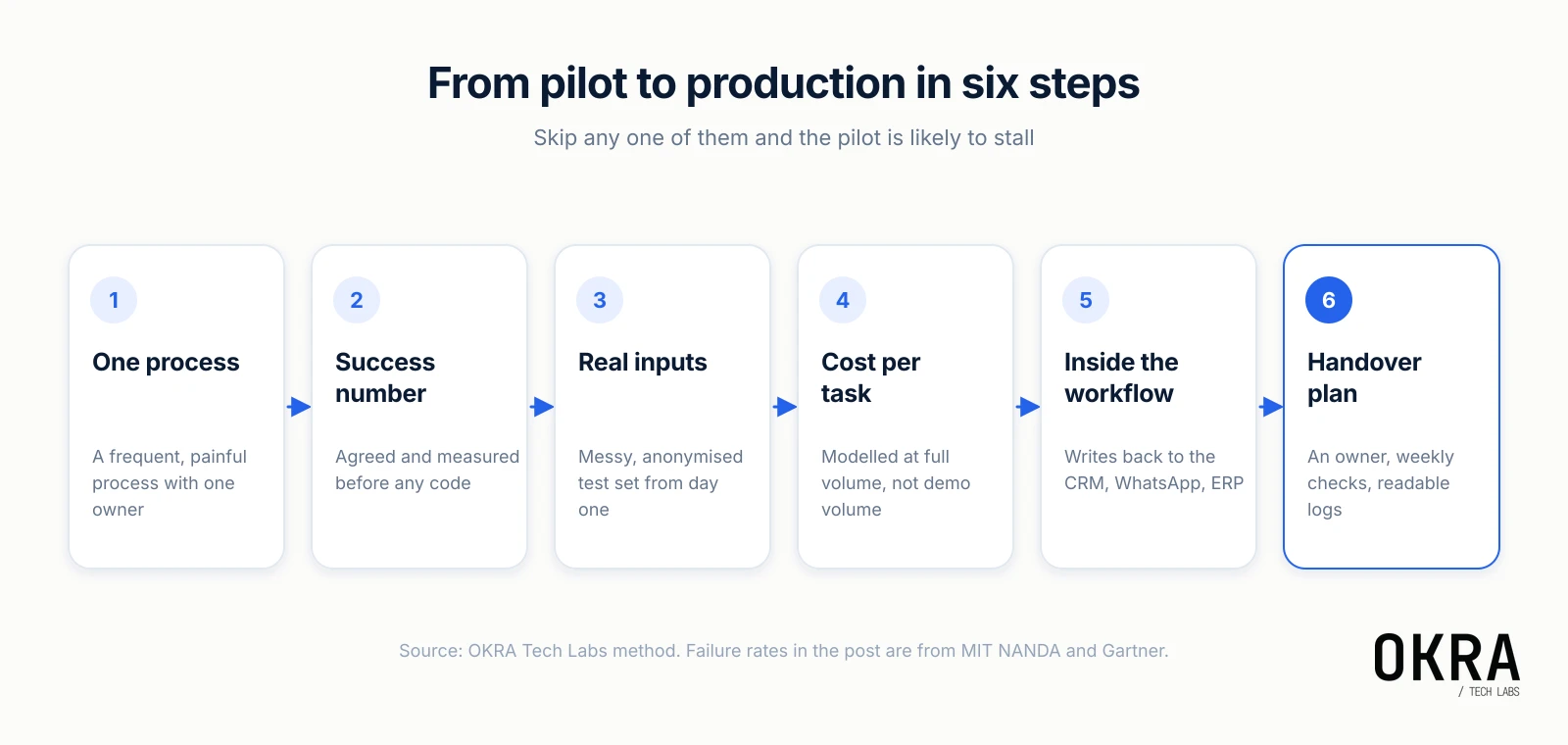
1. Start with one painful process
Pick a single process where the pain is obvious and frequent: leads that go uncalled, invoices typed in by hand, the same ten questions asked all day. A narrow first system that runs every day beats a broad one that impresses once.
2. Write the success measure before writing code
Agree on the number, how it will be measured, and what result means "scale it" or "stop". Measure the current baseline first, so the comparison is honest.
3. Build with real inputs from week one
Collect a test set from the actual process, with the messy cases left in, and anonymise it before it reaches the build team. Run every version of the system against it. This is the single biggest difference between a demo and a product.
4. Model the running cost per task
Estimate the cost of one completed task (one call answered, one invoice processed) at expected volume, including model usage, telephony or messaging, hosting and human review. If the number does not work at scale, change the design now, not after launch.
5. Put it where people already work
Connect the system to the tools the team already uses: the CRM, WhatsApp, the phone line, the ERP. Write its results back into those tools. Add a clear handover to a person for the cases it cannot handle.
6. Plan the handover from day one
Decide who owns the system, what they monitor each week, and how they change it. Give them logs they can read, a way to flag bad outputs, and documentation for the knowledge sources. Then the system improves after the build team steps back, instead of decaying.
A quick checklist before you start a pilot
- One process, one owner, one success number, agreed in writing
- A test set drawn from real, messy inputs
- A cost-per-task estimate at full volume
- A plan for where the output lands (which tool, which screen)
- A human fallback for unclear cases
- A date for the scale-or-stop decision
If you cannot tick all six, the pilot is likely to join the majority that never reach production. If you can, you are already ahead of most of the market.
Questions people ask
What percentage of AI pilots fail?
MIT's 2025 GenAI Divide report found only about 5% of custom enterprise AI tools reached production, and Gartner found at least half of generative AI projects were abandoned after proof of concept by the end of 2025. Definitions differ between studies, but they agree that most pilots stall.
What is the main reason AI pilots fail?
Unclear business value is the most cited reason. Other common causes are poor data quality, costs that grow sharply at scale, weak risk controls and systems that do not fit how people actually work.
How long should an AI pilot take?
Long enough to test on real inputs and measure the goal you set, and short enough that the decision to scale or stop is made while people still care. For a focused use case that is usually weeks, not quarters.
Sources
- The GenAI Divide: State of AI in Business 2025, MIT NANDA, as reported by The Register (August 2025)
- MIT report: 95% of generative AI pilots at companies are failing (Fortune, via Yahoo Finance)
- Why 50% of GenAI projects fail, and how to beat the odds (Gartner)
- Gartner predicts 30% of generative AI projects will be abandoned after proof of concept by end of 2025 (July 2024)
- Gartner predicts over 40% of agentic AI projects will be canceled by end of 2027 (June 2025)