The main DPDP duties (notice, security safeguards, breach reporting within 72 hours, erasure) apply from 13 May 2027. For AI systems that means logging, encryption, processor contracts and a clear map of where customer data goes. Self-hosting models in India is not required for most companies, but it simplifies compliance for sensitive data.
If your business runs a chatbot, a voice agent or any AI system that reads customer names, phone numbers, messages or call recordings, India's data protection law now applies to it in detail. The clock for most obligations runs out in May 2027.
This guide covers what the Rules say, what they mean for AI systems specifically, and when it is worth running models on your own servers in India. It is a practical summary, not legal advice; check your own case with a lawyer.
The timeline
The government notified the Digital Personal Data Protection Rules, 2025 in November 2025, putting the 2023 Act into operation. According to the government's explainer, the Rules give organisations an eighteen-month period for phased compliance.
As The Leaflet's reading of the Rules sets out, the rollout has three stages:
- Immediately (13 November 2025): definitions and the Data Protection Board
- After one year (13 November 2026): registration of Consent Managers
- After 18 months (13 May 2027): the operative duties on businesses, including notice, security safeguards, breach reporting, erasure and the extra duties for Significant Data Fiduciaries
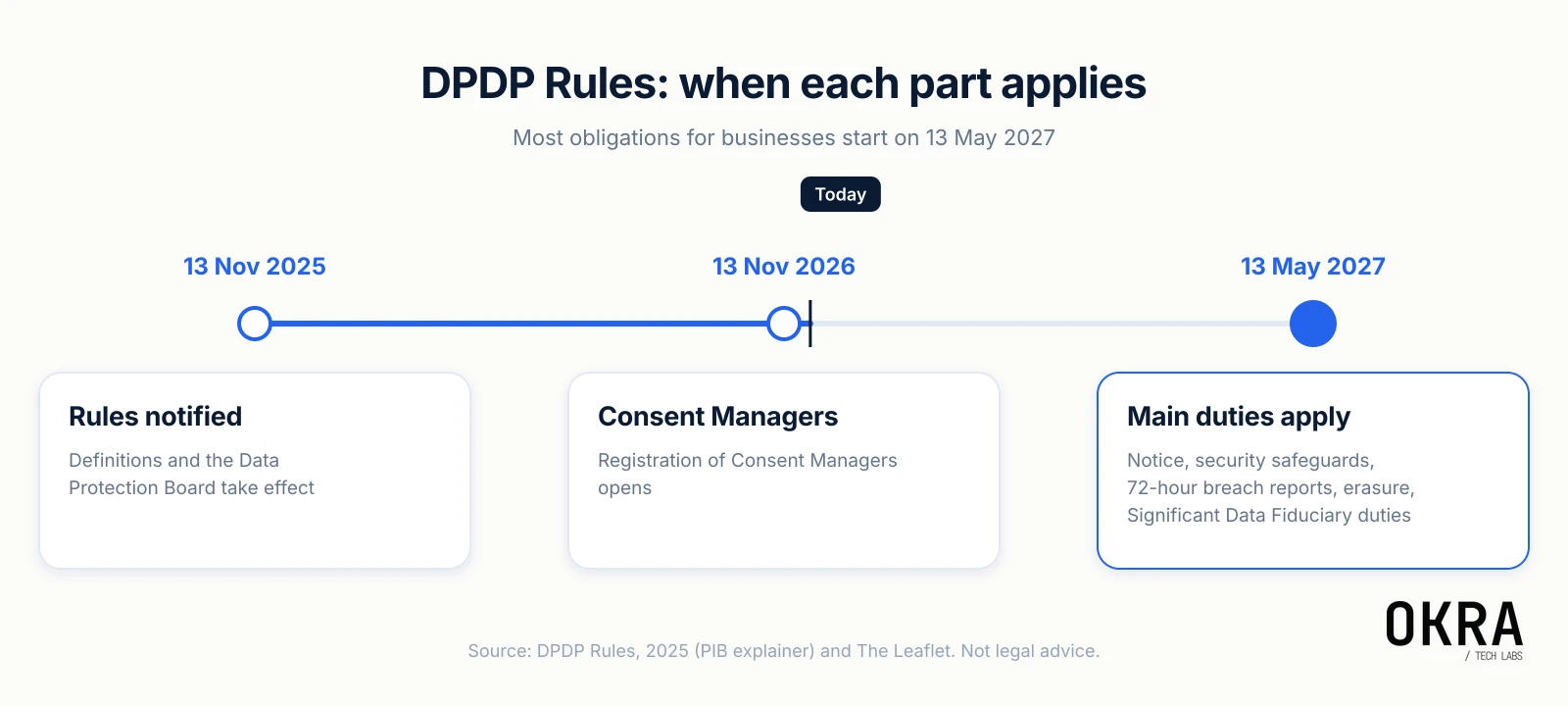
The middle stage has just arrived. The last one is about six months away, which is not long if your AI systems were built without these rules in mind.
What the Rules require, in AI terms
Reasonable security safeguards
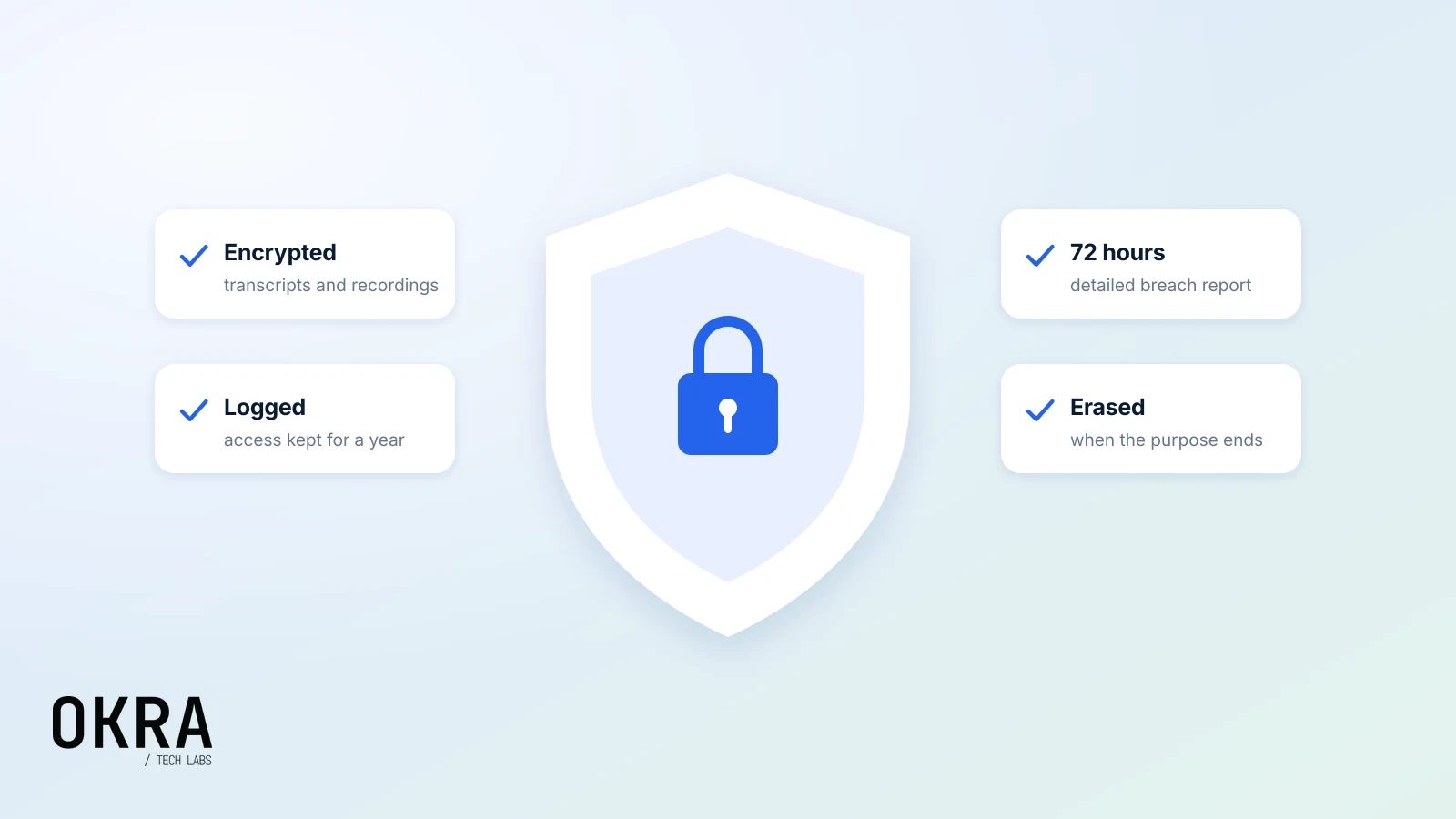
The Rules turn "reasonable security safeguards" into a concrete minimum. The Leaflet lists them: encrypting or tokenising data, strict access control, logging and monitoring access to detect intrusions, and keeping logs and backups for at least one year.
For an AI system, that translates to:
- Transcripts and recordings encrypted at rest, with access limited to named roles
- Prompt and response logs kept for a year, but with personal data masked wherever the log does not need it
- Access logs for anyone who opens a conversation, a recording or a customer record
- Backups of the knowledge base and configuration, so the system can be restored
Breach reporting within 72 hours
If personal data leaks, you must tell affected people and the Data Protection Board without delay, then send the Board a detailed report within 72 hours, as EY's summary explains. For AI systems the practical question is whether you would even know. Prompt injection, a misconfigured storage bucket of call recordings or a model answering one customer with another customer's details all count. Monitoring has to be built in, not added later.
Contracts with every processor
You are the Data Fiduciary; the cloud host, the speech-to-text service and the model provider are Data Processors. The Rules expect your contracts with them to require the same safeguards. List every service that touches customer data in your AI pipeline, and check each contract.
Erasure when the purpose ends
Personal data must be erased once it is no longer needed for the purpose it was collected for. AI systems tend to keep everything: conversation histories, embeddings in a vector database, fine-tuning datasets. Decide retention periods for each, and make sure deletion actually reaches all of them, including the vector store.
The penalties
The government's explainer puts the highest penalty, up to ₹250 crore, on failing to maintain reasonable security safeguards. Biometric Update's summary adds that failing to report a breach can cost up to ₹200 crore.
Does customer data have to stay in India?
For most companies, no. The Act takes a negative-list approach: as SFLC.in explains, the government may restrict transfers to specific countries by notification, rather than approving countries one by one. Data can flow abroad unless a restriction applies, subject to any conditions the government sets.
Two exceptions matter:
- Significant Data Fiduciaries (large or high-risk processors that the government notifies) can be required to keep specified categories of personal data inside India, and must check that the algorithmic software they use does not put people's rights at risk.
- Sector rules still apply. Banks, payment companies, insurers and health providers often have localisation or outsourcing rules from their own regulators that are stricter than the DPDP Act.
When self-hosting models in India makes sense
Running an open-weight model on servers in an Indian data centre, instead of sending data to a cloud model abroad, is not required by the DPDP Act for most companies. It is still the right call in some cases.
Self-hosting is worth it when:
- you handle health, financial or children's data, or a regulator already expects data to stay in India
- you may be notified as a Significant Data Fiduciary
- your contracts with large customers require Indian data residency
- your volume is high and steady enough that owning the compute is cheaper than paying per call
A cloud model is usually fine when:
- the data is low sensitivity, or you can mask personal details before they reach the model
- the provider offers processing in India or a clear processor contract
- your volume is small or unpredictable
A common middle path: keep the sensitive steps (speech-to-text on call recordings, extracting personal details, storing transcripts) on infrastructure in India, mask names and numbers, and only send the masked text to a larger cloud model for the reasoning step.
A checklist to finish before May 2027
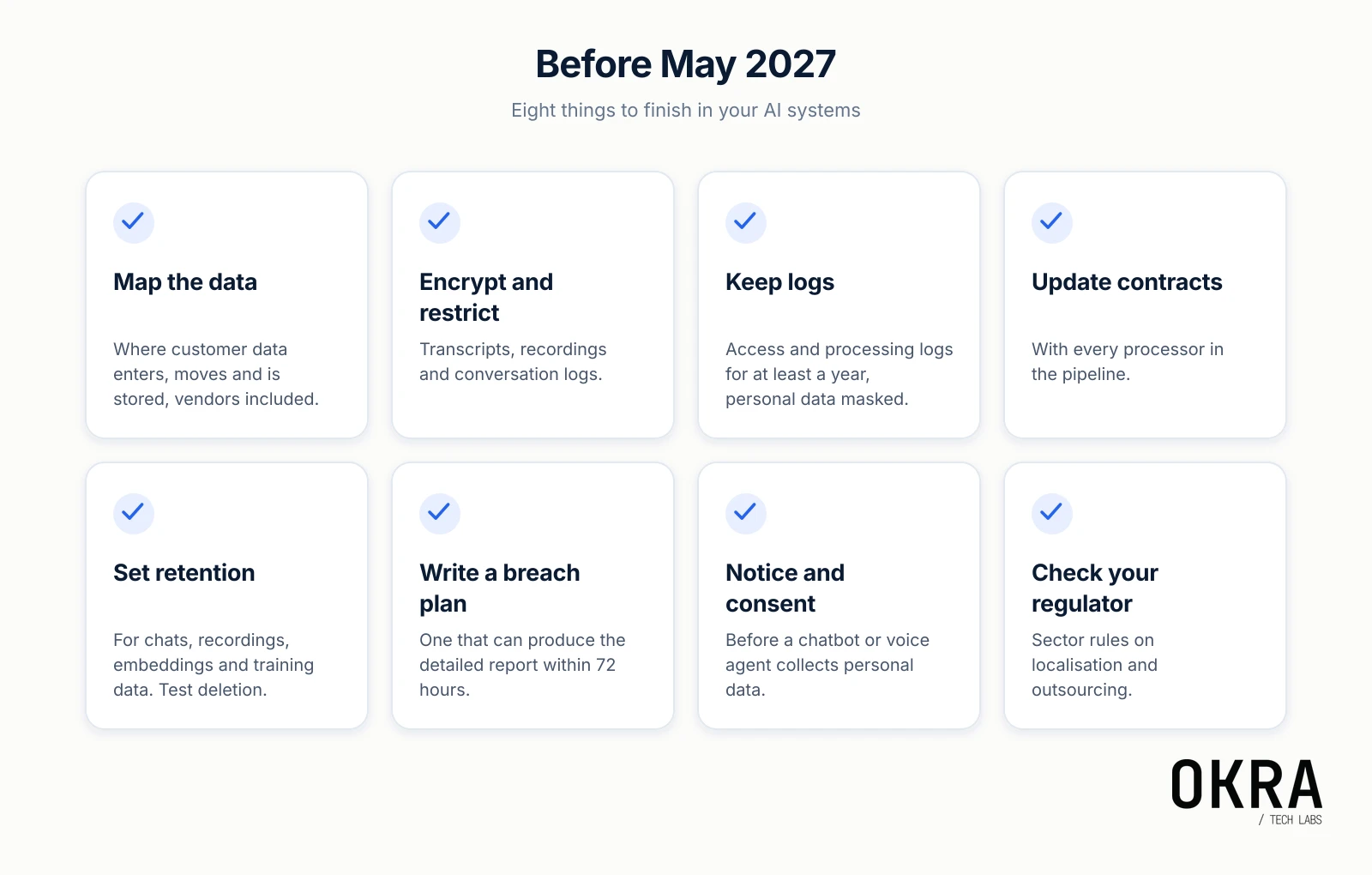
- Map every place customer data enters, moves through and is stored in your AI systems, including vendors.
- Encrypt transcripts, recordings and conversation logs; restrict who can open them.
- Keep access and processing logs for at least a year, with personal data masked where possible.
- Update contracts with every processor in the pipeline.
- Set retention periods for chats, recordings, embeddings and training data, and test that deletion works.
- Write a breach plan that can produce the Board's detailed report within 72 hours.
- Show a clear privacy notice before a chatbot or voice agent collects personal data, and record consent.
- Check your sector regulator's rules on localisation and outsourcing.
None of this is exotic engineering. It is easier to build in now than to retrofit next April.
Questions people ask
When do the DPDP Rules come into force?
They were notified on 13 November 2025 and apply in phases. Definitions and the Data Protection Board took effect immediately, Consent Manager registration from 13 November 2026, and most obligations on businesses, including security safeguards and breach reporting, from 13 May 2027.
Does the DPDP Act require data to stay in India?
Not for most companies. The Act allows transfers abroad unless the government restricts a specific country. Significant Data Fiduciaries can be required to keep specified categories of data in India, and sector regulators such as the RBI have their own localisation rules.
Is using a cloud AI model a DPDP violation?
Not by itself. The model provider is usually your Data Processor. You remain responsible, so you need a contract that requires reasonable security safeguards, clarity on where data is processed and stored, and a way to erase data when the purpose ends.
What is the penalty for a breach under the DPDP Act?
Failing to take reasonable security safeguards can attract a penalty of up to ₹250 crore, and failing to report a breach up to ₹200 crore, per the government's summary of the Rules.
Sources
- DPDP Rules, 2025 notified: government explainer (PIB, 17 November 2025)
- India's Digital Personal Data Protection Act: phased rollout and key compliance milestones (AZB & Partners via Mondaq)
- India's new Digital Personal Data Protection Rules 2025: a detailed reading (The Leaflet)
- Transforming data privacy: DPDP Act, 2023 and DPDP Rules, 2025 (EY India)
- DPDP Rules, 2025: Significant Data Fiduciaries and data transfers (SFLC.in)
- India notifies its sweeping Digital Personal Data Protection Rules (Biometric Update)