GPT-6.2 Astra is OpenAI's model for its hardest professional work: polished documents, slides and spreadsheets, financial and legal drafting, research, and front-end or 3D builds from a written brief. Test it on high-value deliverables where quality matters more than cost, and use GPT-6.2 Sol for everyday volume.
OpenAI released GPT-6.2 Astra on 17 November, nearly two months after it scrapped a planned update to put stronger safeguards in place. It is positioned as OpenAI's model for complex professional projects, and it ships alongside GPT-6.2 Sol, a cheaper model for everyday work.
Launch posts are full of benchmark charts. This one is about what a business can actually do with the model this quarter, and how to test it without wasting money.
What changed in GPT-6.2 Astra
In its launch post, OpenAI makes four main claims:
- Better professional deliverables. Documents, slides and spreadsheets that follow your templates and the conventions of fields like law, sales, finance and accounting, and read less like AI output.
- Stronger front-end and 3D work. Cleaner code and better-looking websites, games and 3D designs, including turning a written brief into an interactive browser experience.
- Science and legal work. OpenAI calls it its strongest model for scientific work, and a legal configuration called Astra for Law leads its legal deliverables benchmark.
- Lower cost per task. OpenAI prices Astra at $8 per million input tokens and $40 per million output tokens in the API, 20% below the previous Astra, and says it uses fewer output tokens to finish a task.
One caution before you rebuild anything around it. Benchmarks published by a lab are a starting point, not a verdict. Early independent results were mixed: Wccftech's roundup reported strong scores on Artificial Analysis' general intelligence index but no improvement on its coding agent index over the previous Astra. Test it on your own work.
1. Board packs, reports and decks that follow your template
The most immediate use is the work that eats senior people's weekends: the monthly board pack, the quarterly business review, the investor update.
Give the model your last approved deck as the template, the raw numbers as a spreadsheet, and a short brief on what changed this quarter. Because Astra is trained to follow templates and field conventions, the first draft should need fewer formatting passes, so reviewers can spend their time on the argument and the numbers.
Example (illustrative): a Gujarat-based manufacturer's finance team feeds in plant-wise production and dispatch sheets and gets back a draft monthly review deck in the company's own format, with a variance table and a one-page summary for the promoters.
Keep a person on: every number. Have the system cite which cell each figure came from, so a reviewer can check them quickly.
2. Financial models and accounting work
OpenAI's launch post quotes accounting platform Basis reporting time savings on long-horizon accounting work, and highlights better spreadsheets and financial models. For Indian and Gulf businesses, good first tests are:
- building a three-statement model from historical financials and stated assumptions
- reconciling a ledger export against bank statements and flagging mismatches
- preparing GST or VAT working papers in your existing format for an accountant to review
Keep a person on: assumptions and anything filed with a regulator. Treat the output as a well-organised first draft.
3. Contract and compliance drafting
Legal teams are an obvious fit given the legal benchmark results OpenAI reports. Useful starting points:
- first drafts of NDAs, vendor agreements and leave-and-licence agreements from your own clause library
- comparing a counterparty's draft against your standard positions and listing every deviation
- turning a new circular or regulation into a checklist for the operations team
Keep a person on: final sign-off, always. Ask the model to cite the clause or section behind each point so a lawyer can check it fast.
4. Landing pages, demos and 3D walkthroughs from a brief
This is the newest capability: turning a written brief into a working, interactive page. For marketing and sales teams that means:
- campaign landing pages built from a brief and your brand guidelines, ready for a developer to review and ship
- interactive product demos for sales calls
- simple 3D views of a product or space for early-stage buyers
Example (illustrative): a real estate developer turns a project brief and floor plans into an interactive browser walkthrough of a sample flat that the sales team can share on WhatsApp before a site visit.
Keep a person on: accessibility, performance and brand. A page that looks good in a demo still needs to load fast on a mid-range phone.
5. Research briefs for mixed audiences
OpenAI cites trading firm IMC using the model for briefings and diagrams aimed at both technical and non-technical readers. Most companies have the same need: one piece of research, three audiences. Good tests:
- a market-entry brief for a new city or country, with a one-page version for the board
- a competitor teardown from public filings, product pages and press coverage
- a technical explainer of a new regulation, with a plain-language version for the sales team
Keep a person on: sources. Require links for every claim and spot-check them.
When GPT-6.2 Sol is enough
Astra is the expensive option. OpenAI prices GPT-6.2 Sol at $2 per million input tokens and $10 per million output tokens, and reports it coming within 0.5 points of Astra on one coding benchmark at about one-fifth of the cost.
A sensible split for most businesses:
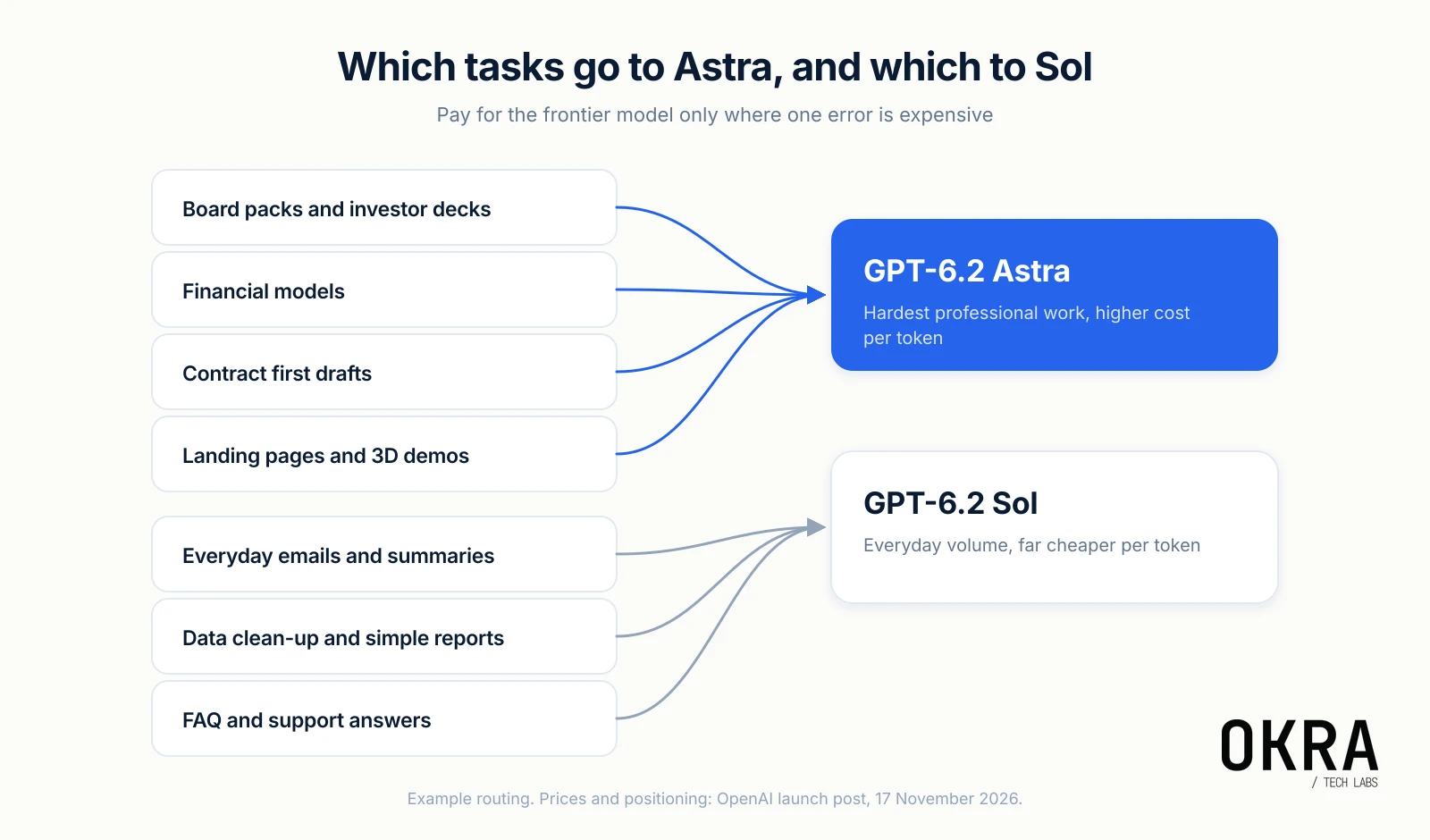
| Use Astra for | Use Sol for |
|---|---|
| Board packs, investor material, legal drafts | Everyday emails, summaries, internal notes |
| Complex models and multi-sheet analysis | Data clean-up and simple reports |
| Front-end, demo and 3D builds | Routine support and FAQ answers |
| Work where one error is expensive | High-volume, low-risk tasks |
How to test it in a week
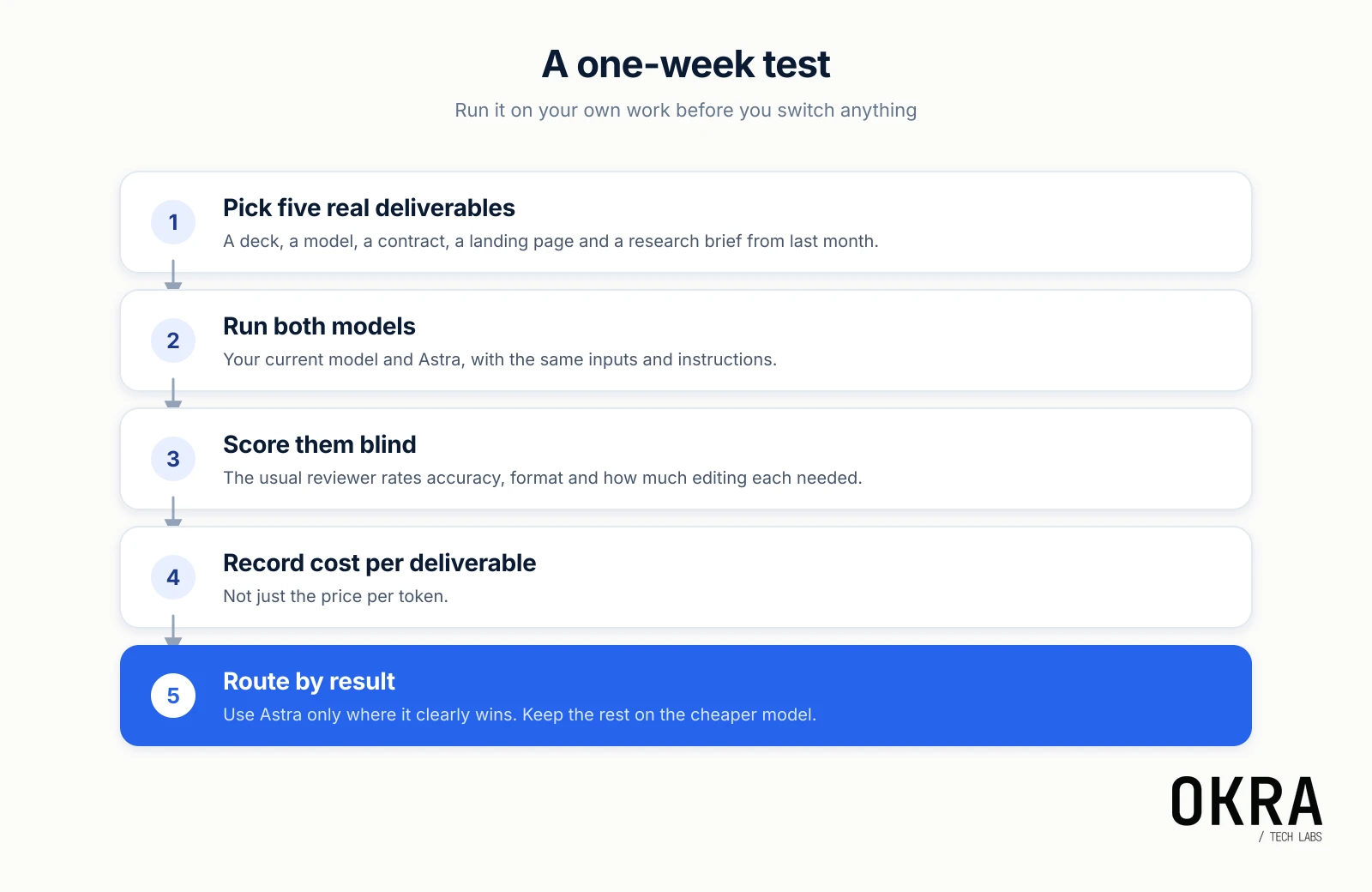
- Pick five real deliverables from last month, such as a deck, a model, a contract, a landing page and a research brief.
- Run them through your current model and Astra with the same inputs and instructions.
- Have the usual reviewer score both blind, on accuracy, format and how much editing they needed.
- Record cost per deliverable, not just price per token.
- Route by result. Use Astra only where it clearly wins, and keep everything else on the cheaper model.
Keep customer and personal data out of the test unless your contract with the provider covers it. Model launches come every few weeks now; a repeatable test like this lets you take advantage of each one without rebuilding your stack every time.
Questions people ask
When was GPT-6.2 Astra released?
OpenAI announced GPT-6.2 Astra and GPT-6.2 Sol on 17 November 2026. Both are available in ChatGPT Work and Codex on Plus, Pro, Enterprise and Edu plans, and in the API as gpt-6.2-astra and gpt-6.2-sol.
What is the difference between GPT-6.2 Astra and GPT-6.2 Sol?
Astra is the higher-capability, higher-cost model for the hardest projects. Sol is the efficient everyday model, designed for multistep agentic work and clear writing, and costs much less per token.
Is GPT-6.2 Astra good for coding?
OpenAI highlights cleaner code and better front ends, especially websites, games and 3D. Independent results are mixed: at least one independent index showed no gain on coding agent tasks over the previous Astra, so test it on your own codebase.
Should a business switch to GPT-6.2 Astra?
Not wholesale. Run it side by side with your current model on a small set of real deliverables, compare quality, review time and cost per task, then route only the work where it clearly wins.