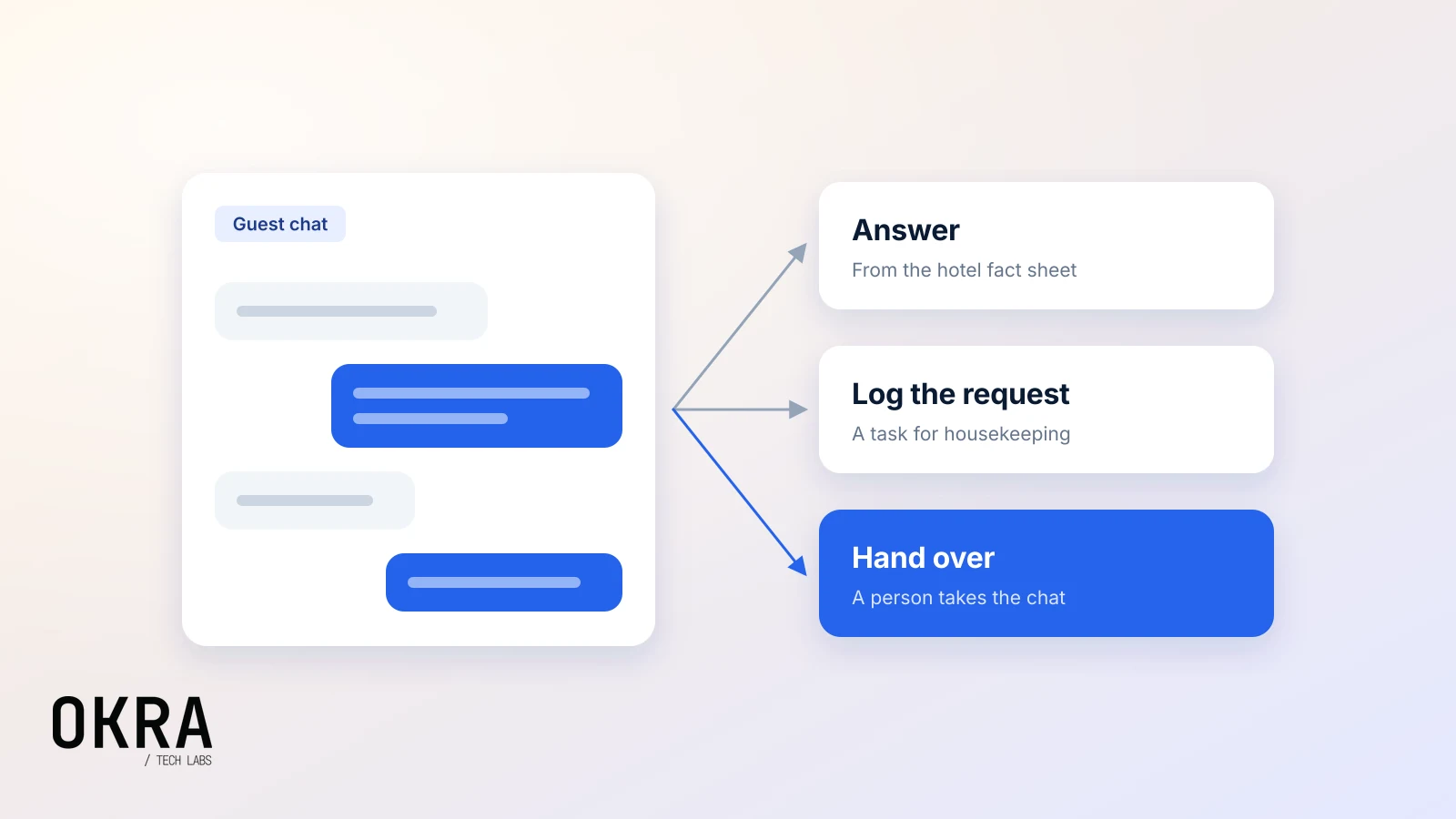
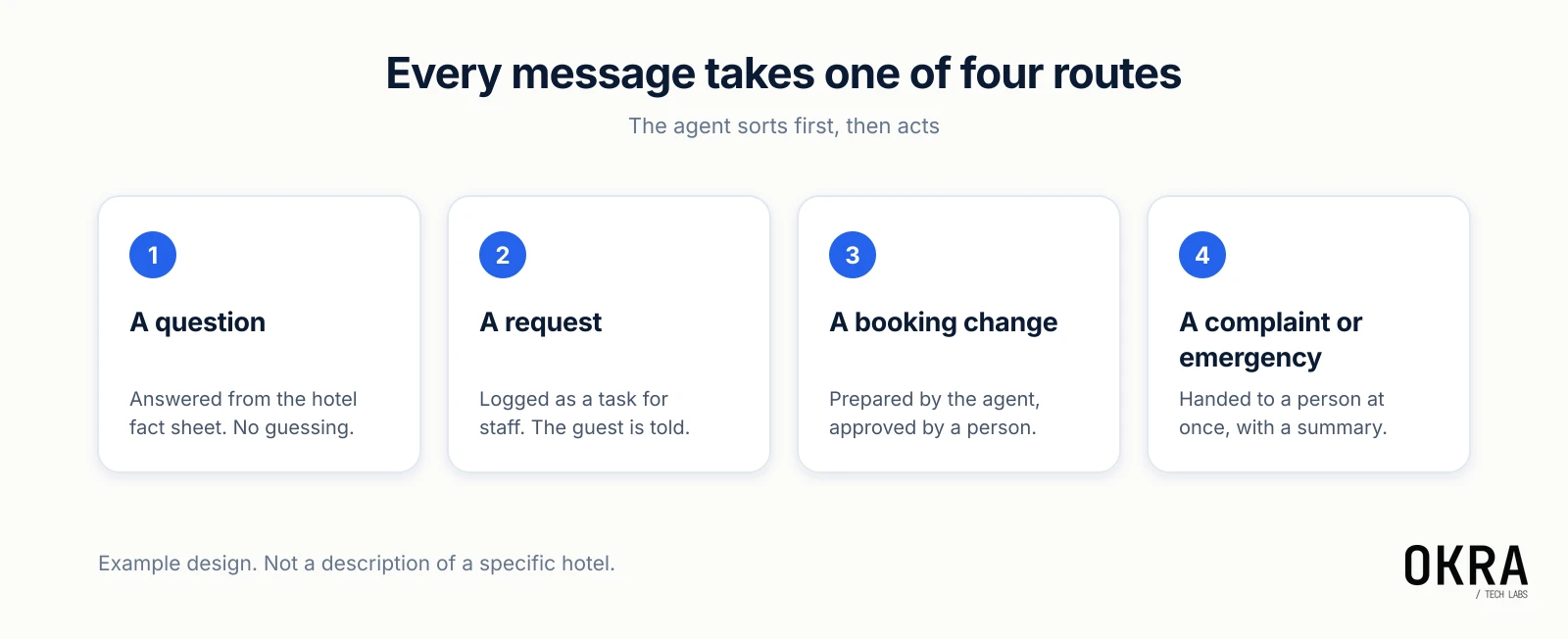
A guest-message agent reads each incoming message, sorts it into one of four kinds (question, request, booking change, or complaint), and treats each differently. It answers questions from the hotel's own information, logs requests as tasks for staff, prepares booking changes for a person to approve, and hands complaints and emergencies to a human at once, with a summary. This post describes an example design, not a specific hotel.
It is 11.40 at night. A guest arriving tomorrow messages the hotel on WhatsApp: can she check in at 9 am, and is there a cot for her daughter? The front desk has one person on duty, and he is dealing with a late arrival. The message waits until morning.
This post walks through an example design for an AI agent that handles messages like that one. It is an illustration of how such a system is put together, not an account of a particular hotel. We use it because it shows, in a small space, most of the decisions that matter in any customer-facing agent.
What guests are open to
Guests are more willing to use this than many hoteliers assume. A 2022 study by Oracle Hospitality and Skift, which surveyed 5,266 travellers in nine countries, found that 77% were open to automated messaging or chatbots for customer service requests. India was not among the countries surveyed, so read it as a signal, not a forecast.
The core idea: sort first, then act
The mistake in a first design is one large prompt that tries to do everything. The better pattern is what Anthropic's guide to building effective agents calls routing: classify each input, then send it to a path built for that kind of input. The guide gives customer service as the natural case, where general questions, refund requests and technical problems each go to their own process.
For a hotel, four routes cover nearly everything.
Route 1: a question
"What time is breakfast?" "Is there parking?" "How far is the airport?" The agent answers from the hotel's own fact sheet: timings, facilities, policies, directions. A hotel's fact sheet is small, so the whole of it can sit in the prompt. No search system is needed, as we explain in our guide to RAG, fine-tuning and prompts.
One firm rule: if the fact sheet does not contain the answer, the agent says it will check with the team. It does not guess.
Route 2: a request
"Two extra towels to room 304." "A cot for tomorrow." The agent does not fulfil these. It records them: room, item, time, guest name, in whatever the housekeeping team already uses, whether that is the property system or a shared task board. It then tells the guest the request has been passed on.
The cot in our opening example is a request. The agent logs it for the morning shift and says so.
Route 3: a booking change
Early check-in, an extra night, a room upgrade. These touch availability and money, so the agent prepares and a person decides. It reads the booking, checks what the system shows, and sends the front desk a one-line proposal: "Guest in booking 4471 asks for 9 am check-in tomorrow; the room is vacant tonight. Approve?" Staff tap yes or no, and the agent replies to the guest.
Could the agent approve it alone? Technically, yes. But a wrong early check-in means a guest standing in a lobby with a room that is not ready. Start with approval, and remove it later for the cases that prove safe.
Route 4: a complaint or an emergency
"The AC is not working and nobody has come." "My father is unwell." The agent does not try to resolve these. It hands the conversation to a person immediately, with a short summary so the guest is not asked to repeat anything, and tells the guest a member of staff is taking over.
The path of one message
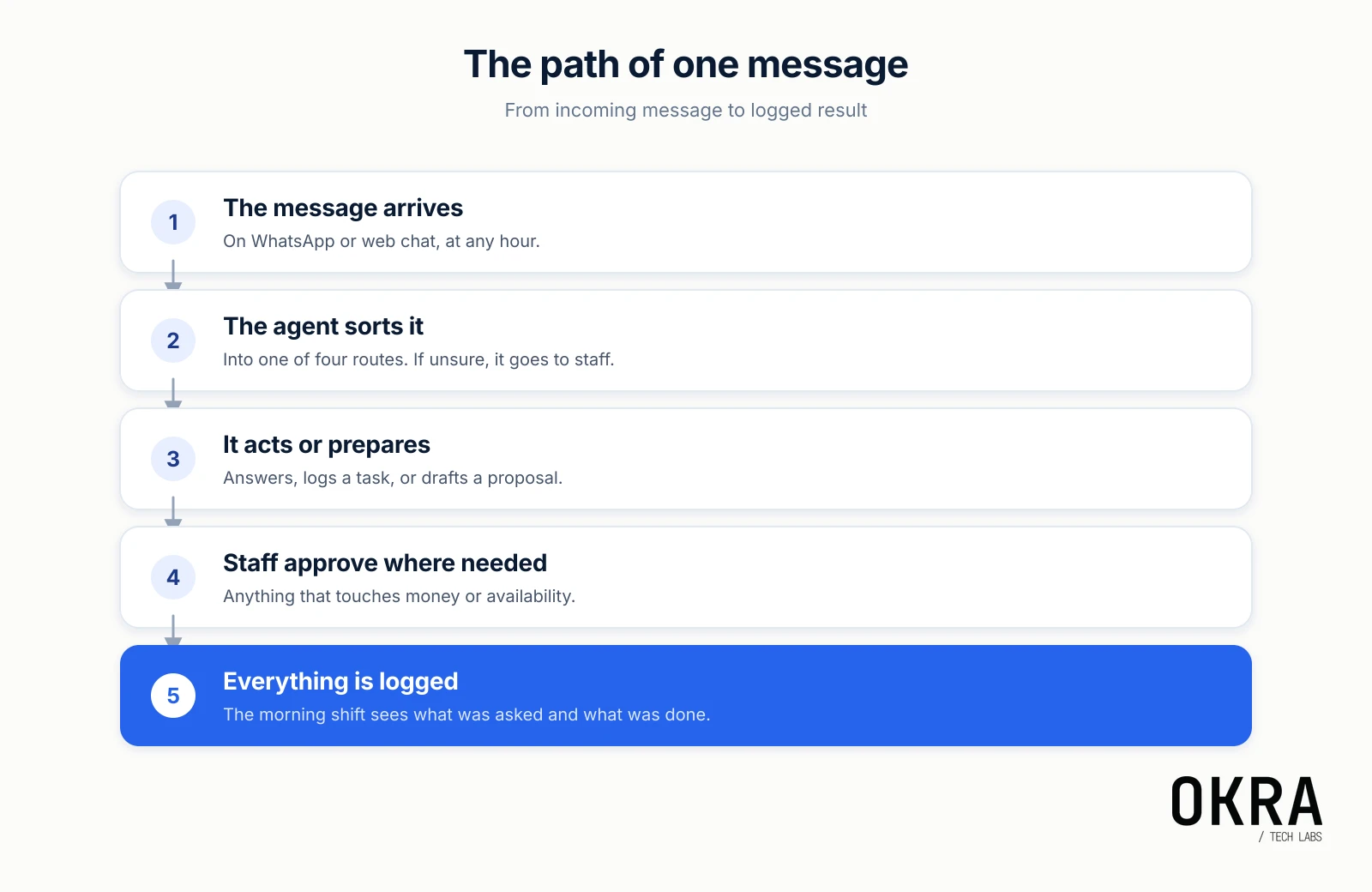
- The message arrives on WhatsApp or web chat.
- The agent sorts it into one of the four routes. If it is unsure, it treats the message as one for staff.
- It acts or prepares: answers, logs a task, or drafts a proposal.
- Staff approve where money or availability is involved.
- Everything is logged, so the morning shift can see what was asked and what was done overnight.
What the WhatsApp rules mean for the design
WhatsApp has rules that shape how the agent works, and they are worth knowing before the build. Meta's pricing documentation describes them:
- The 24-hour window. When a guest messages the hotel, a 24-hour timer starts and resets with each new message from the guest. Inside it, the hotel can reply openly. Outside it, only pre-approved templates can be sent.
- Charging is per message. Since 1 October 2026, ordinary replies inside the window are no longer unlimited: each business number gets 1,000 a month before charges begin. An agent that sends five short messages where one would do now has a cost.
- Consent comes first. Meta's opt-in rules require that a person has agreed to receive messages from the business before it writes to them.
So the agent should answer fully in one message, and reminders such as "your room is ready" need an approved template.
Guest data
Guest messages contain names, phone numbers, travel dates and sometimes health details. India's data protection rules, notified in November 2025, require clear notice and consent, and safeguards for personal data. In the design that means telling guests at the start that they are talking to an automated assistant, keeping transcripts encrypted, and setting a date after which they are deleted. Our post on the DPDP Rules and AI systems has the detail.
What we would test before launch
- Every question on the fact sheet, asked three different ways.
- Questions the fact sheet does not answer, to confirm the agent admits it.
- Messages that mix two routes: "Extra pillows please, and can we check out late?"
- Angry messages, and polite ones that should not be escalated.
- Messages in each language the hotel supports, checked by a native speaker.
Our guide to testing an AI system before it goes live explains how to turn a list like this into a repeatable test set.
Back to the guest at 11.40 pm. With this design she gets a reply within the minute: early check-in has been requested and the front desk will confirm in the morning, and a cot has been arranged. The night manager never left the lobby.
Questions people ask
What can a hotel guest-message agent answer on its own?
Questions with a settled answer in the hotel's own information: check-in and check-out times, breakfast hours, airport transfers, parking, pool timings, directions and policies. It should not make up prices or availability; those come from the booking system or from staff.
Does the agent replace the front desk?
No. It takes the repeated questions and logs routine requests so that staff can spend their time on guests who need a person. Complaints, emergencies and anything involving money go to staff.
Can a hotel message guests on WhatsApp at any time?
Not with ordinary messages. Meta's rules allow open replies only within 24 hours of the guest's last message. Outside that window the hotel has to use a pre-approved message template, and the guest must have agreed to receive messages.
Which languages should it handle?
The languages your guests write in. For most Indian hotels that means English and Hindi plus the Indian regional languages of your main markets, each reviewed by a native speaker before launch.
Sources
- Building effective agents (Anthropic, December 2024)
- Pricing on the WhatsApp Business Platform (Meta for Developers)
- Get opt-in for WhatsApp (Meta for Developers)
- Hospitality in 2025: consumer research study (Oracle Hospitality and Skift, June 2022)
- Government notifies DPDP Rules (Press Information Bureau, 14 November 2025)