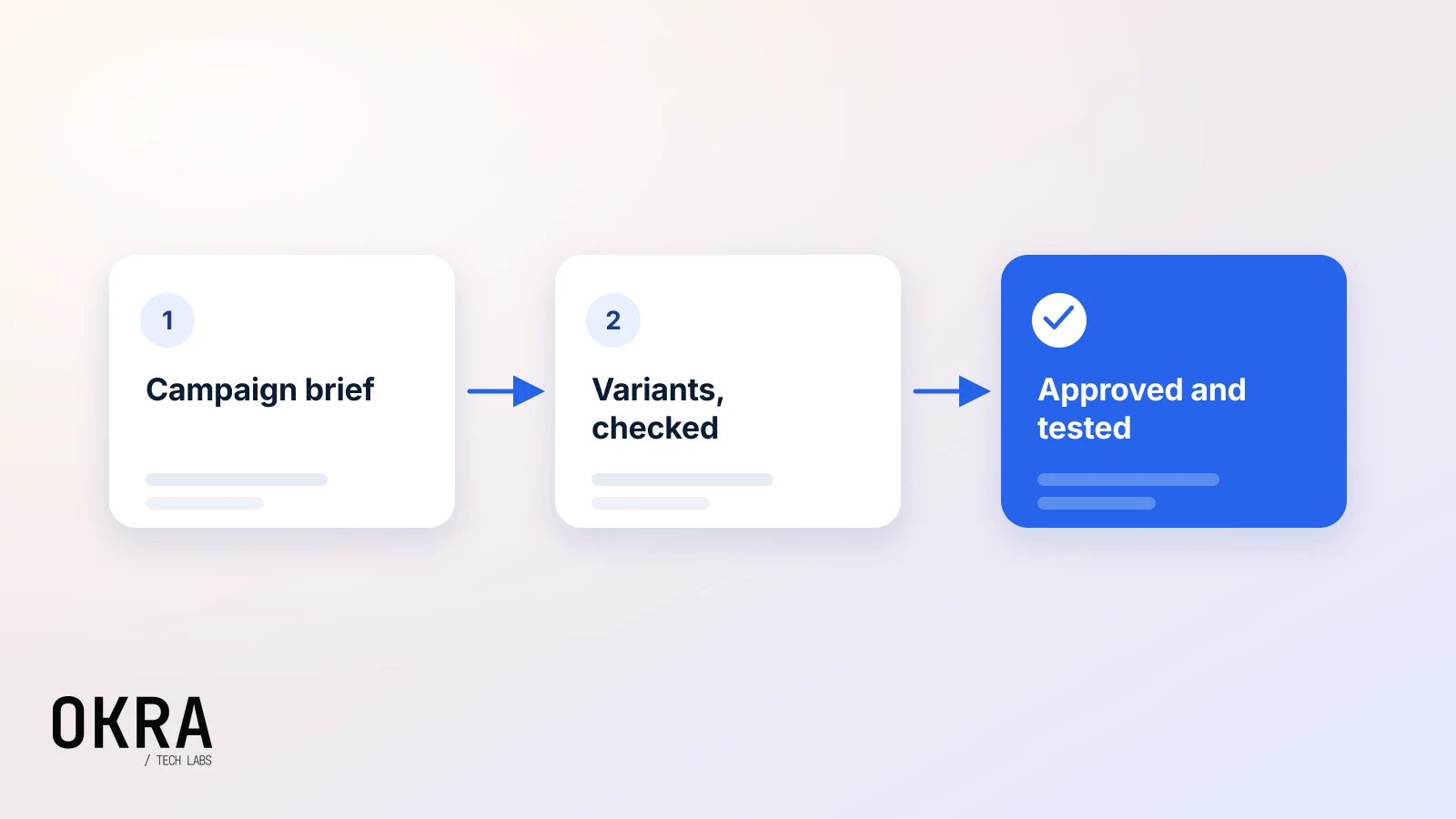
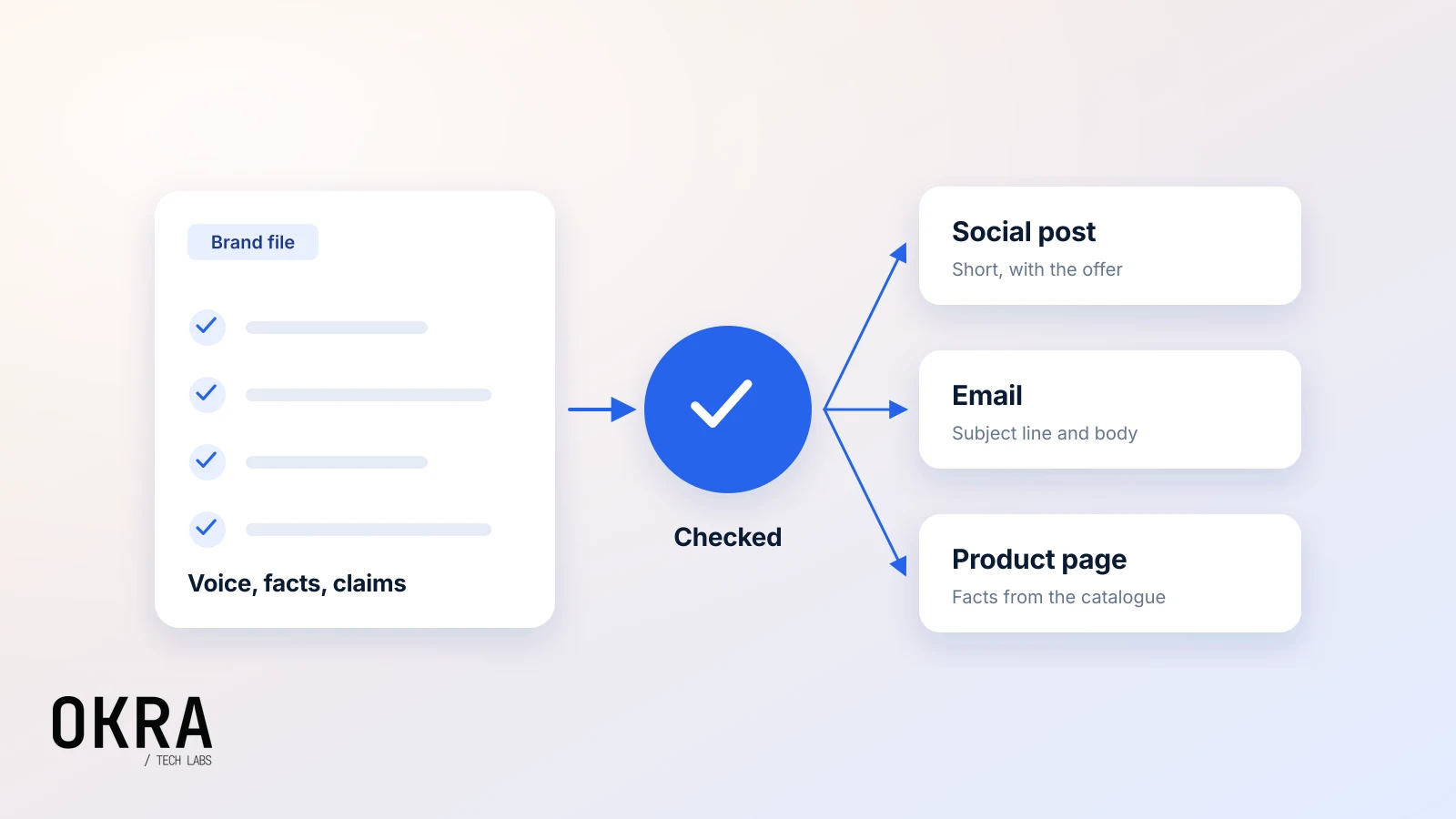
A content engine is a pipeline, not a button. It has five stations: a brand file that holds the voice rules and product facts, a short brief written by a person, drafts made by a model one step at a time, automatic checks against the facts and the rules, and human approval before anything is published. The checks and the approval step are what make the output safe to publish. This post describes an example design, not a specific brand.
Picture the marketing team of a packaged snack brand. Two people. This week they owe a festive offer on social media, an email to past buyers, new text for six product pages and a message for the retailers' group, in English, Hindi and Gujarati. Each piece is small. Together they fill the week, and the first thing to slip is checking.
A content engine is built for that team. This post walks through an example design. It is an illustration of how such a system is put together, not an account of a particular brand.
A pipeline, not a button
Most teams start by pasting a request into a chat window and editing what comes back. That works for one post. It does not hold up for a hundred, because nothing remembers the brand's rules and nothing checks the result.
A content engine fixes both. It is a fixed set of steps, which in the terms of our guide to agents, chatbots and workflow automation makes it a workflow with AI steps inside it. The model writes. The pipeline around it decides what may go out.
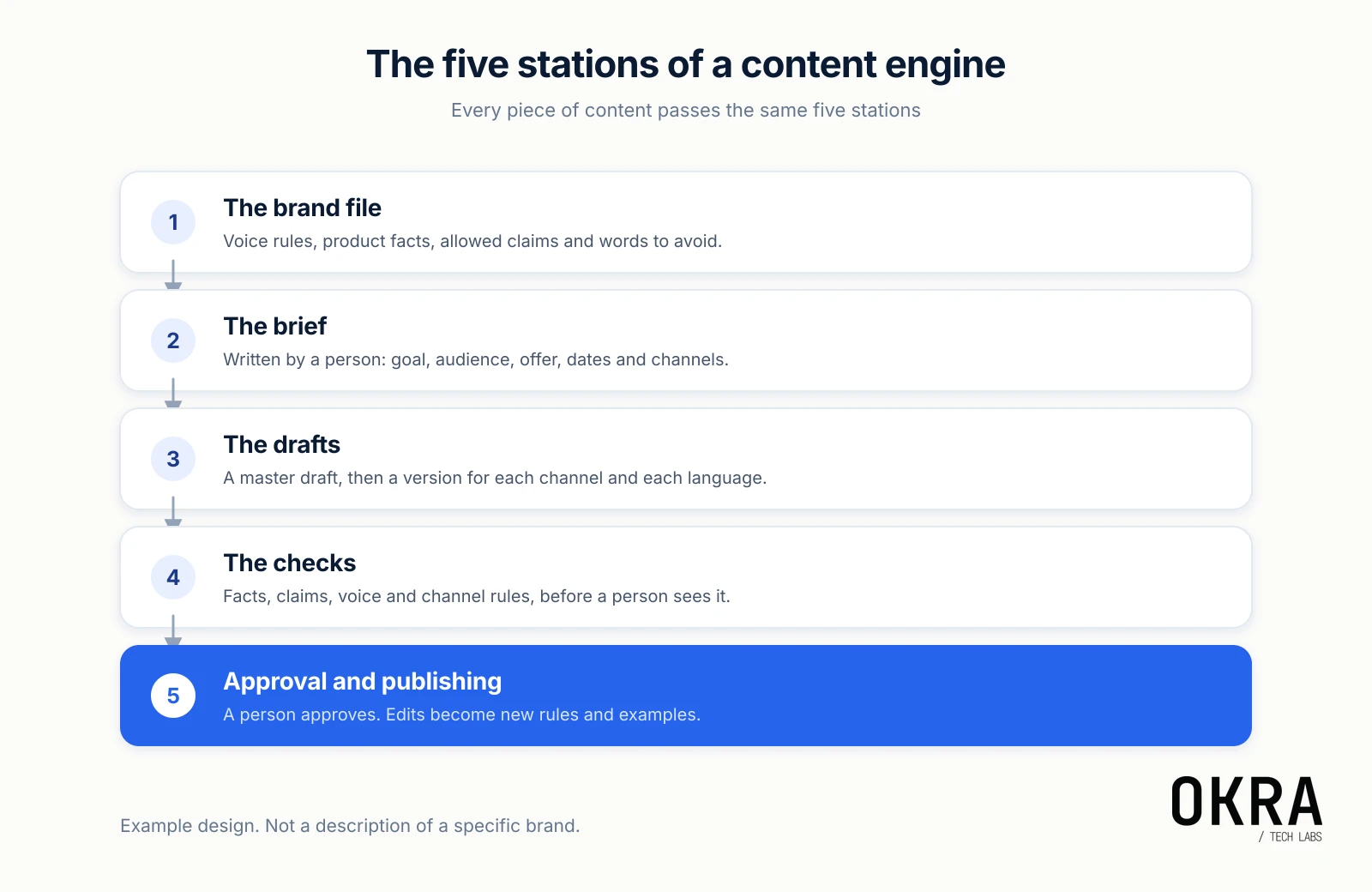
Station 1: the brand file
Everything the engine knows about the brand sits in one place, and people keep it up to date.
- Voice rules. How the brand talks, with five or six real posts the team is proud of. Examples teach a model more than adjectives do.
- Product facts. Names, ingredients, pack sizes, shelf life, and prices pulled from the catalogue, not typed by hand.
- Allowed claims. The exact claims the brand can support, and the ones it must never make. "No added sugar" either appears here or it cannot be used.
- Words to avoid. Competitor names, health promises, anything legal has said no to.
For most consumer brands this file is small enough to give the model in full each time. A search system is needed only when the catalogue runs into thousands of items, as our guide to RAG, fine-tuning and prompts explains.
Station 2: the brief
A person writes the brief, and it is short: the goal, the audience, the offer, the dates, the channels, and the one thing the reader should do. The engine does not decide what the campaign is. If the brief is vague, the drafts will be too, so the form has required fields and will not run without them.
Station 3: the drafts
One large prompt that asks for everything at once gives uneven results. The engine breaks the work into small jobs, each with one purpose.
- A master draft. The core message, written from the brief and the brand file.
- A version for each channel. A social caption, an email with a subject line, a product page paragraph. Each has its own length and shape.
- A version for each language. Written again for Hindi or Gujarati readers, not translated word for word. Idiom and festival references change with the language.
Images are a separate job. The engine can suggest what a picture should show, and a designer or an image model makes it, with the rules below in mind.
Station 4: the checks
This is the station that separates an engine from a chat window. Every draft is tested before a person sees it, with the cheapest check that can do the job.
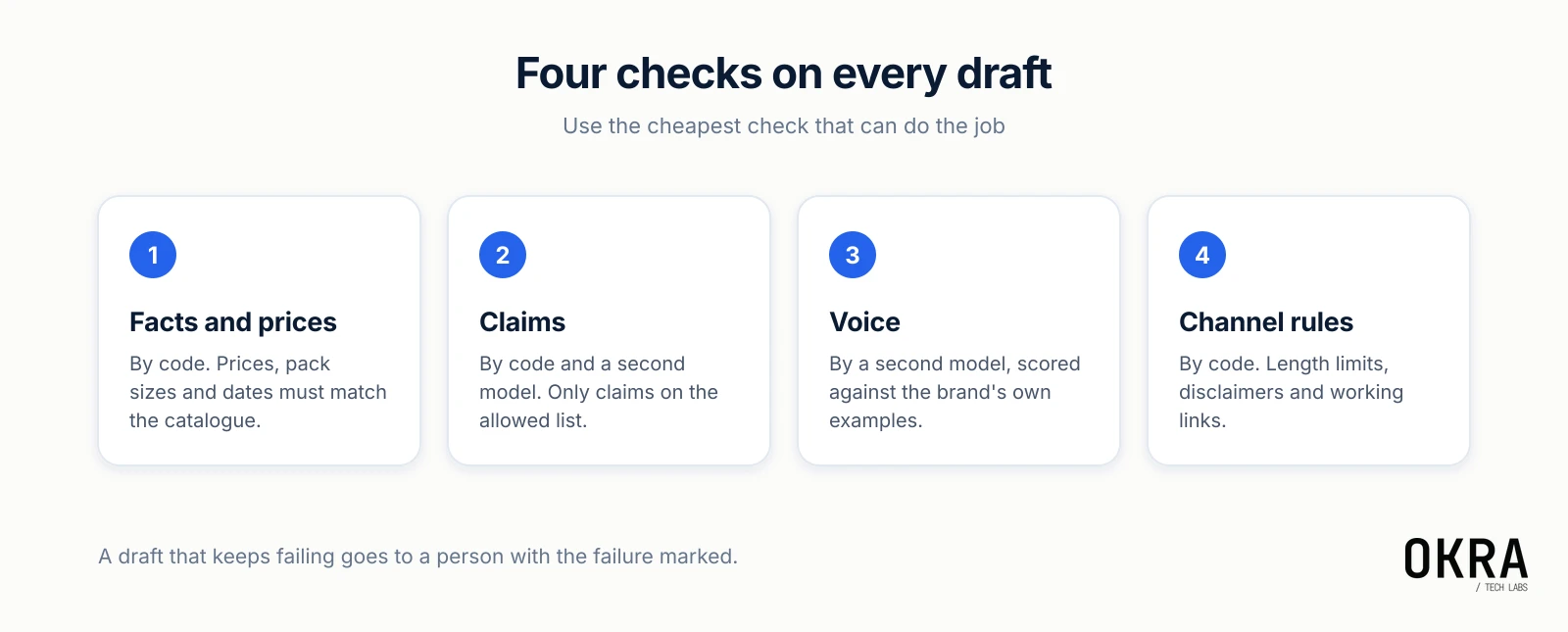
- Facts and prices, by code. Every price, pack size and date in the draft must match the catalogue and the brief.
- Claims, by code and a second model. Any claim about health, results or comparison must be on the allowed list.
- Voice, by a second model that scores the draft against the brand's own examples and sends weak ones back for another attempt, with the reason.
- Channel rules, by code. Length limits, required disclaimers, links that work.
A draft that fails goes back to Station 3 once or twice. If it still fails, it is passed to a person with the failure marked, not hidden. Our post on testing an AI system before it goes live covers how to build the test set that keeps these checks honest.
Station 5: approval, publishing and learning
A person approves each piece in a simple queue: approve, edit, or reject with a reason. Approved pieces are scheduled in the tools the team already uses. Edits and rejections are the most useful output of the whole system. Each one becomes either a new rule in the brand file or a new example, so the same mistake is not made twice.
Why keep a person in the loop
Because the evidence says people still add something. In April 2025, Deloitte Digital ran a blind test with 1,000 US consumers, who rated marketing emails for a fictional activewear brand without knowing who wrote them. The AI-written emails scored about 4.5% better on qualities such as clarity and relevance. But the emails written by people were 6.4% more likely to get the top ratings for willingness to act, which is the thing a marketer is paid for. The test was small in scope: one country, one kind of content, and very little brand context given to either side. Read it as a signal that AI drafts and human judgement do better together.
It also helps to start where the tools are strongest. In a BCG survey of 251 marketing leaders, the uses they ranked highest were mostly structured content such as copywriting, editing and social posts, well ahead of video and animation. That is the work a content engine does.
The ad rules the engine has to follow
In September 2026 the Advertising Standards Council of India issued guidelines on labelling AI-generated content in advertising. They take effect three months after publication, and the brand is the one held responsible, as exchange4media reported. Three points shape the design.
- Text is treated lightly. Writing or improving advertising copy with AI needs no label. The claims in that copy must still follow the ASCI Code.
- Realistic audio and video are not. A synthetic brand ambassador, a real person's cloned voice (even with consent), or a product shown doing something it has not done needs a clear label such as "Video created using AI".
- Some things are out, label or not. Made-up testimonials, before-and-after results that cannot be supported, and anyone's likeness used without consent.
So the engine never writes a testimonial, the image step flags anything that shows a realistic person, and the approval screen shows whether a label is needed.
What to measure
Count what the team feels: the time from brief to approved piece, the share of drafts approved without edits, how many errors the checks caught before a person did, and how many reached a person anyway. If the last number is not falling, fix the brand file before anything else.
Where to start
Do not build all of it at once. Take one channel and one product line, write the brand file, and run the engine beside the current process for a few weeks. Add channels when the approval queue becomes boring, because boring is what dependable looks like.
Back to the two-person team. On Monday they write one brief. By the afternoon the queue holds every piece for the week, each already checked against the catalogue and the claims list. They spend their time on the ones that need a human eye.
Questions people ask
What is an AI content engine?
It is a set of connected steps that turns a short campaign brief into drafts for each channel, checks those drafts against the brand's facts and rules, and sends them to a person for approval. The model writes; the pipeline around it decides what is allowed to go out.
Can a content engine publish without a person checking?
It can, but it should not at the start. Begin with a person approving everything. Later, low-risk items such as a restock notice can be allowed through on their own once the checks have proved dependable for that kind of item.
Does AI-written ad copy need a label in India?
Under the guidelines ASCI issued in September 2026, advertising text written or improved with AI does not need a label. Realistic AI-made audio or video that could affect a buyer's decision does, and some uses, such as made-up testimonials, are not allowed even with a label. The claims in the copy must still follow the ASCI Code.
Which languages can a content engine write in?
English, Hindi and the Indian regional languages your buyers read. Treat each language as its own piece of writing, not a word-for-word translation, and have a native speaker review it before it is published.
Sources
- Guidelines for Responsible Labelling of Synthetically Generated Content in Advertising (ASCI, September 2026)
- ASCI issues guidelines on responsible labelling of AI-generated ad content (exchange4media, September 2026)
- GenAI is ready now. Are your marketing operations? (Deloitte Digital, December 2025)
- GenAI Promised a Creative Revolution. Can Marketers Deliver? (BCG, 2025)