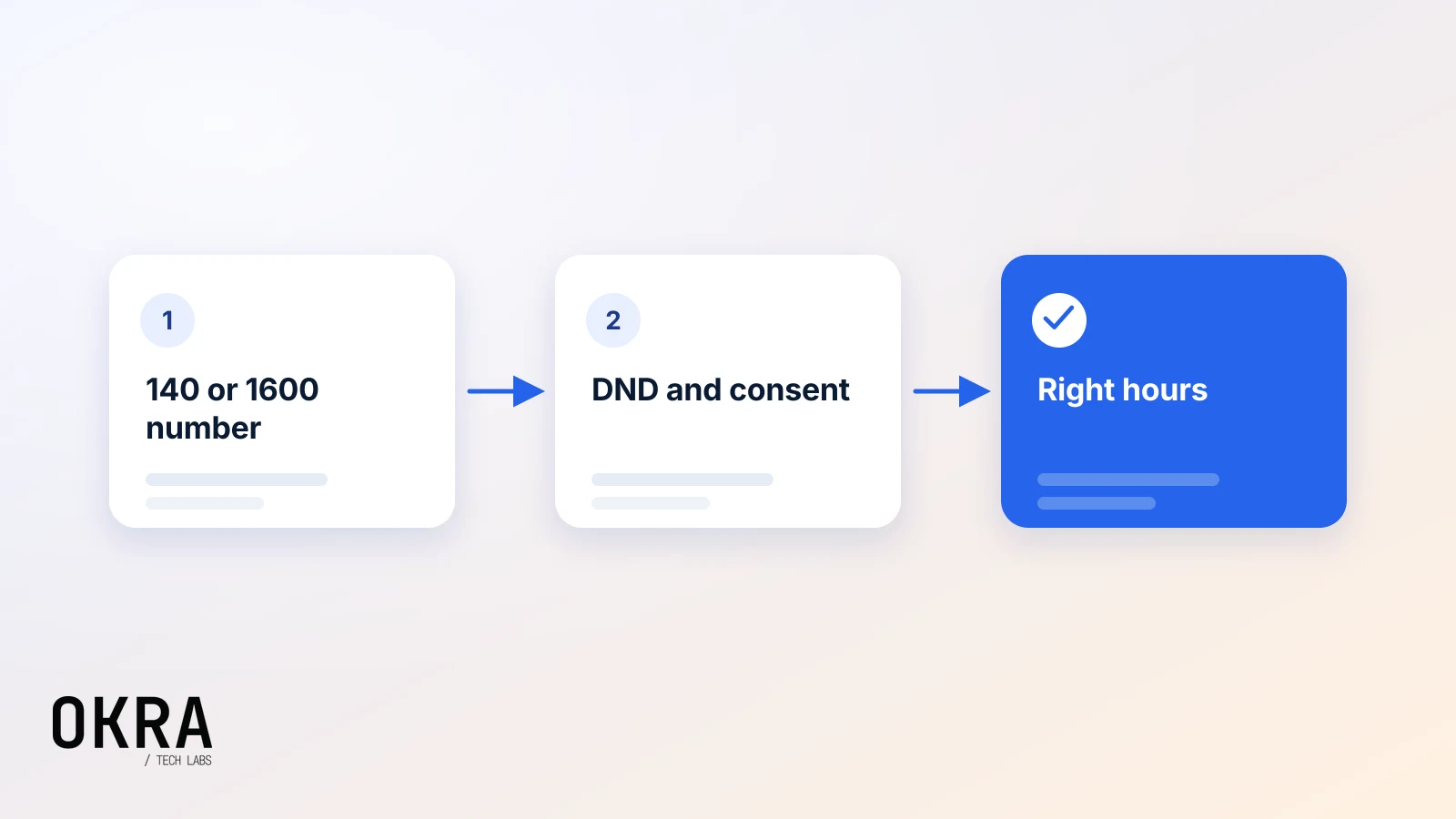
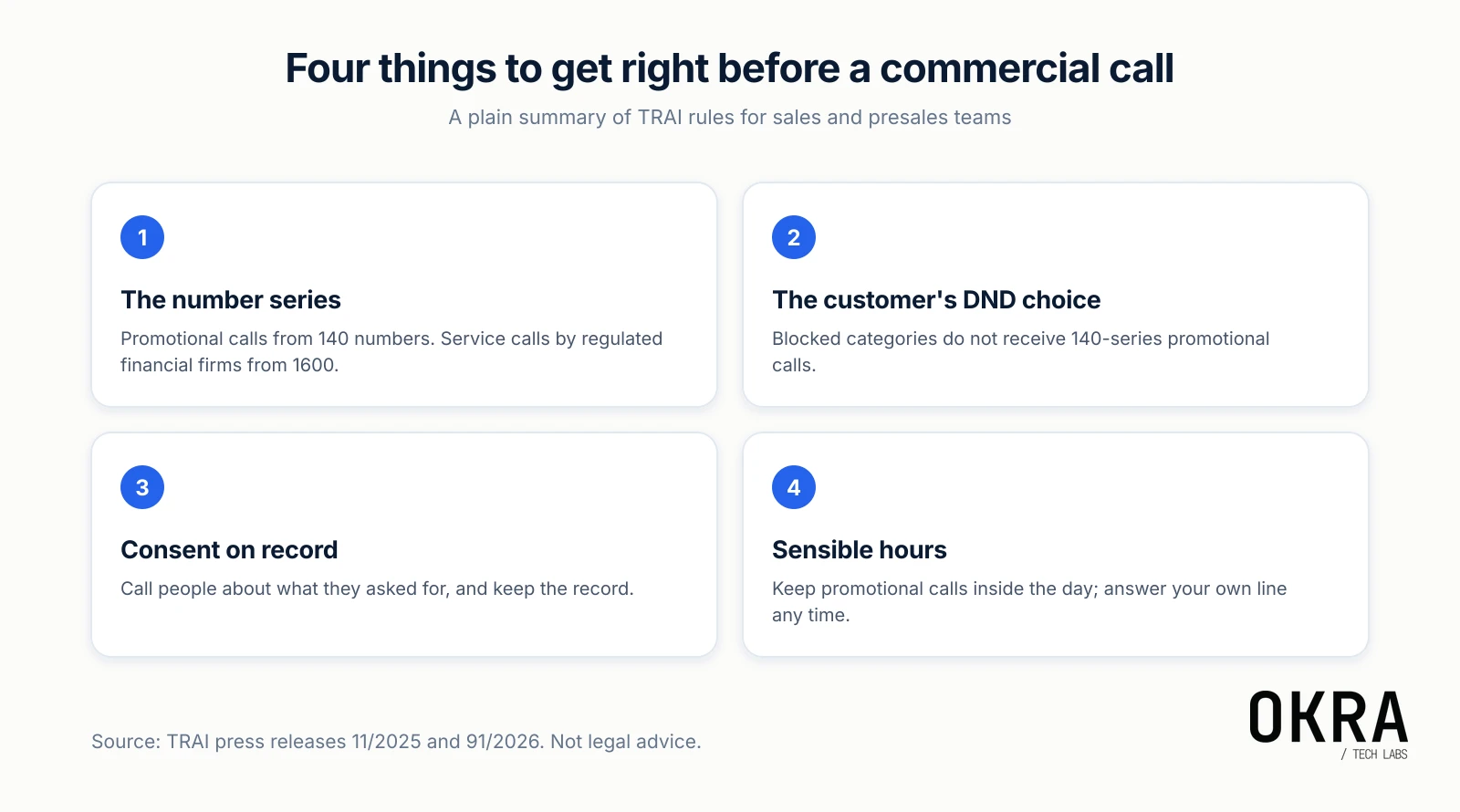
Promotional calls in India must come from numbers in the 140 series, and they are blocked for anyone who has set a DND preference for that category. Service and transactional calls from regulated financial firms must come from the 1600 series. Commercial calls also need consent, the right number series and sensible hours. A team that keeps promotional calls inside the day, honours DND, records consent and calls people who asked to be called stays on the right side of the rules.
Every sales head in India has heard some version of "we can't call before ten" or "that number will get blocked". Most of it is half right. This post sets out what the Telecom Regulatory Authority of India (TRAI) rules actually ask of a team that calls customers, in plain words, so you can check your own process.
This is a practical summary, not legal advice. The rules change often, so check the current TRAI text before you build a calling campaign.
The rules in one paragraph
Commercial calls in India are governed by TRAI's Telecom Commercial Communications Customer Preference Regulations, first issued in 2010 and rewritten in 2018, known as TCCCPR. They decide which numbers you may call from, whom you may call, and how customers can say no. TRAI amended them again in February 2025 to tighten the number series, consent and penalties, as set out in its press release on the amendments.
Which number you call from
This is the part that changed most.
- Promotional calls come from the 140 series. TRAI has mandated 140xx numbers for promotional calls by entities of any sector. A business that wants to make promotional calls registers with a telecom operator under the TCCCPR framework.
- Service and transactional calls come from the 1600 series. The same clarification reserves 1600 numbers for service and transaction calls by regulated banking, financial services and insurance firms. Operators may not block, filter or tag calls from 1600 numbers.
- Ordinary ten-digit mobile numbers are not for telemarketing. Running sales campaigns from staff SIM cards is exactly what the 2025 amendment set out to stop.
For a builder, a clinic or a hotel, the question to ask is simple: is this call selling something the person did not ask about? If yes, it is promotional and belongs on a 140 number.
What DND means for you
DND is the "do not disturb" registry. A customer can block all promotional calls, or only some categories such as real estate or banking, through the TRAI DND app, their operator, or by calling or sending an SMS to 1909.
TRAI's July 2026 clarification is plain about the effect: a customer who has blocked a category will not receive 140-series promotional calls from businesses in that category. Your promotional campaign simply does not reach them. Trying to get around it with other numbers is what attracts penalties.
Consent: the enquiry is not a blank cheque
The 2025 amendment put more weight on explicit consent. In practice:
- Someone who asked you to call can be called about what they asked for. A buyer who filled in your form for a 3 BHK can be called about that enquiry and a site visit.
- Keep the record. The form, the time, the page and the consent wording. If a complaint comes, this is your answer.
- Do not stretch it. The same buyer has not agreed to hear about your other projects, loans or offers forever. That is a fresh promotional message.
- Make stopping easy. If someone says "don't call me", mark it and stop, across every number you use.
What hours to call
The original 2010 rules barred commercial calls between 9 pm and 9 am. Under the 2018 regulations, the government told Parliament that the default window for marketing calls to mobile users is 10 am to 9 pm, and customers can choose their own time bands.
The safe practice for any promotional call is to stay inside 10 am to 9 pm, and to avoid Sundays and holidays unless the customer asked for a call then. Calls the customer started, such as a returned missed call or a booking they made, are a different matter: answering your own phone line at night is fine.
What this means for AI calling
An AI voice agent is treated like any other caller. The rules care about the call, not who is speaking. So the same checks apply:
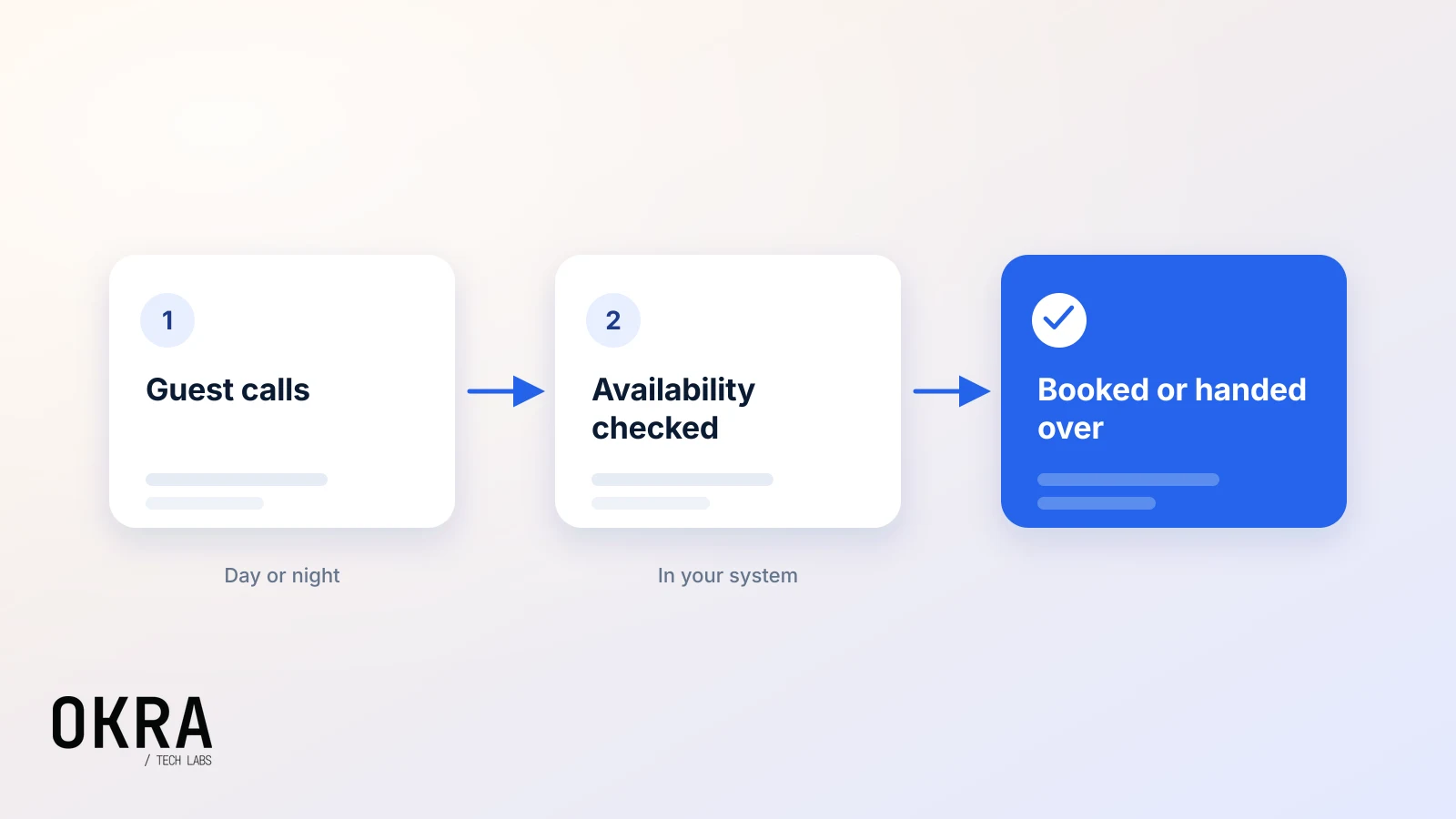
- Answering inbound calls on your own number, day or night, is the safest use. The customer called you.
- Calling back a fresh enquiry, about that enquiry, with a consent record, during the day, is the next safest.
- Cold promotional calling to bought lists is where both the law and the results go wrong, with or without AI.
When we set up AI calling for builders in Gujarat, the calling window, the number series, DND checks and the consent record are configured before the first call goes out, and the agent stops calling anyone who asks it to.
A checklist for your team
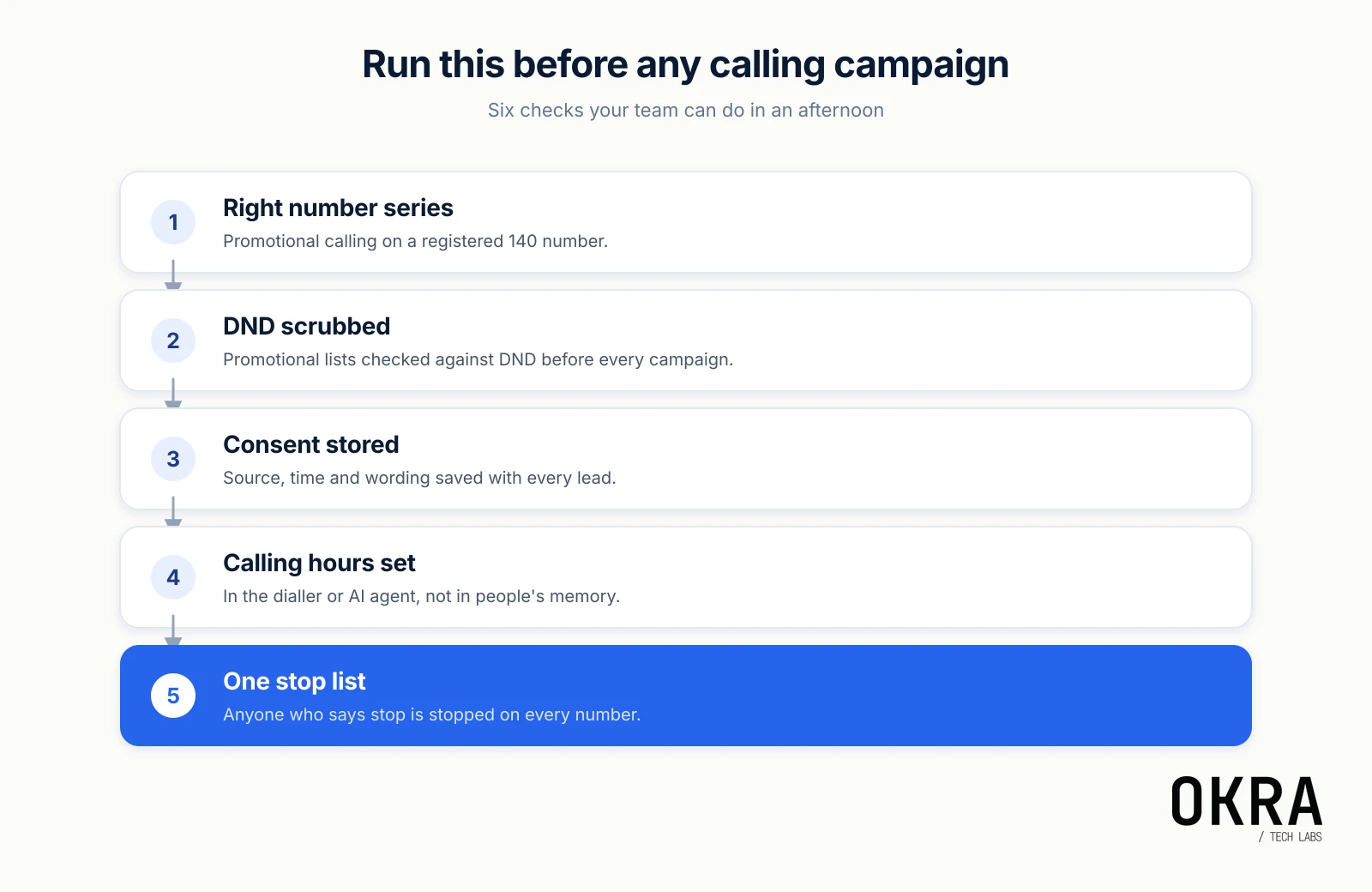
- List every number your team uses to call customers. Move promotional calling to a registered 140 number.
- Check whether you are a regulated financial firm that must use 1600 numbers for service calls.
- Scrub promotional lists against DND before every campaign.
- Store consent with every lead: source, time and wording.
- Set calling hours in your dialler or AI agent, not in people's memory.
- Keep a single stop list and apply it everywhere.
Get these six right and most of the stories about blocked numbers stop applying to you.
Questions people ask
What is the 140 series in India?
Numbers starting with 140 are reserved for promotional calls. TRAI requires businesses in any sector to use them for promotional calls, and customers who have blocked a category on the DND registry will not receive 140 calls from that category.
What is the 1600 series?
Numbers starting with 1600 are for service and transactional calls. TRAI has made them mandatory for regulated banking, financial services and insurance firms, and operators may not block or tag calls from them.
Can I call a lead who filled in my website form?
A person who asked to be contacted about your project has given you a reason to call about that enquiry. Keep a record of the form, the time and the consent wording, call about what they asked for, and do not add them to unrelated promotional campaigns.
Do the rules apply to AI voice agents?
Yes. The rules cover the call, not who or what is speaking. An AI agent must use the right number series, respect DND and calling hours, and follow consent in the same way as a human caller.
Sources
- TRAI press release 11/2025: amendments to TCCCPR, 2018
- TRAI press release 91/2026: clarifications on the 1600 and 140 series
- TCCCPR (Second Amendment) Regulations, 2025 (TRAI)
- Telecom Commercial Communication Customer Preference Regulations, 2010 (Wikipedia)
- Unsolicited telemarketing call complaints (BloombergQuint)